Showing posts with label generation. Show all posts

Tuesday, September 3, 2019

Sleuthing the Kirkpatricks

It has been a very long time since I have posted. I have been researching, but apparently haven't felt like blogging in a long time.

With that being said, I am meeting with a DNA cousin tomorrow and I brought a ton of unlabeled photographs to share with him in the hopes he might recognize some people. I have also been posting photos on the Kirkpatrick Genealogy Facebook page, hoping maybe someone there might know the people. Alas, it seems that there are many Kirkpatricks which came to this country in the mid-1700s, but mine came over in about 1831, and I have yet to meet a Kirkpatrick cousin from that larger group. Whereas my family stayed in Troy, NY, the rest of the Clan seems to have headed south and west.

BUT, the person I am meeting tomorrow is absolutely a Kirkpatrick cousin and from the Troy, NY area. So I know he is family.

I recently had an "aha!" moment when I realized that I recognized a house in the background. Guessing on the children, I assumed the photograph was from 1900 and I looked at the census for that address and sure enough, the people I assumed were in the photograph were all living in the house together at the time.

The first photograph below I know all the people.

Nellie Jane Kirkpatrick Lee with sons Herbert "Herb" and Horace "Harry"

This photograph was labeled - and I do know the house - Kirkpatricks after the porch and fence taken.


And this third photograph was the mystery. But based on the known children above, the 1900 Census, and other photographs of the house, I think this must be Martha Jane Wright Kirkpatrick holding Harry with little Herb standing in front.


As of a few years ago, the house looks like this:


The house has seen some better days.

This was a house in my family for generations. Through the census documents, one can see first that Charles and Nellie Jane lived there with her brother and sister-in-law, and Nellie and Oliver are in and out a couple times, and then Martha Jane's father is there with them for a while before his death, and then Oliver and Nellie raise their children there. Must have been a sad day when the house was sold and Olive moved with her parents Oliver and Nellie to Bronxville, NY.

Thursday, July 28, 2016

Brick Wall comes down - Anna Brechbill

I found the name of a second great grandmother of my husband's - Anna Brechbill. Unfortunately, no other little leaves are shaking at me, but a name! A family! And it is an unusual name! She shows up on the death certificates of three of her children.

I guess this will take a little more digging and not a passive receipt of information. Shoot. Eventually I need to get myself to Western Pennsylvania to do the original research.

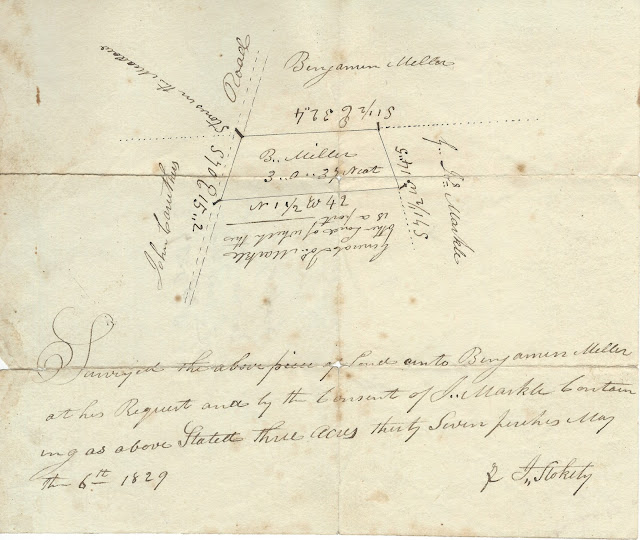
I did discover - or should I say rediscover - an 1829 survey among mu husband's papers. It has a name on it - Benjamin Miller - though I have not connected *that* name to the tree. John A. Miller, yes, so I am assuming Benjamin is a father or grandfather, but I don't yet know. I mean, why else would my husband have that survey if it weren't a family member. I have several deeds and sales receipts for land owned by the family over time.

The daughter of John A Miller, Lucy Miller, married Thomas Robertson and died young, before her father. I lucked out and found a Will for John A. Miller and he names his children and grandchildren, of which one is my husband's grandfather. Such good stuff!

Friday, November 13, 2015

A child-size change of heart

Genealogy is what has done it for me - not that I will have children... But thinking about this endless chain of babies which links me to the very first humans. It's pretty magical and wondrous when you think about it.

I remember reading about happiness and what was concluded is that the best prediction of your feelings about a subject are those of other people... Again, the context was happiness, but if other people love/enjoy something, chances are you will too. Unless, I suppose one is an incredible outlier, but who are we kidding, we are all pretty much the same... unique, but not totally unique. (I feel like that graduation speech, everyone is unique, but not special! ha!)


Taken from the July 3rd print edition of the Week Magazine.

For years, I insisted I didn’t want children, said Michelle Goldberg. But life is full of surprises.

Twelve years ago, I penned an essay for a Salon.com series called “To Breed or Not to Breed,” about the decision to have children or not. It began this way: “When I tell people that I’m 27, happily married, and that I don’t think I ever want children, they respond one of two ways. Most of the time they smile patronizingly and say, ‘You’ll change your mind.’ Sometimes they do me the favor of taking me seriously, in which case they warn, ‘You’ll regret it.’” The series inspired an anthology titled Maybe Baby. It was divided into three parts: “No Thanks, Not for Me,” “On the Fence,” and “Taking the Leap.” My essay was the first in the “No” section.

So I felt a little sheepish when, a year and a half ago, the writer Meghan Daum asked me if I’d be interested in contributing to the book that would become Shallow, Selfish and Self-Absorbed: Sixteen Writers on the Decision Not to Have Kids. I wrote back to tell her that I couldn’t: My son had just turned 1.

My transformation didn’t begin with an unbidden outbreak of baby lust or a sudden longing for domesticity. It began, weirdly enough, when I learned about corpses becoming fathers. In 2011, I reported a piece for Tablet Magazine about the strange Israeli campaign for posthumous reproduction. Israel is the world capital of reproductive technology, and a legal group called New Family wanted to give parents who had lost adult sons the right to extract their sperm and create grandchildren. I have mixed feelings about making dads out of dead men, but I remember being seized by the realization that if my husband were to die young, I’d want to be able to do it to him.

Children, I suddenly understood, would hedge against the unthinkable fact of my husband’s mortality. Not long ago, I learned the Arabic word Ya’aburnee from a friend’s cheesy Facebook graphic. Literally “You bury me,” it means wanting to die before a loved one so as not to have to face the world without him or her in it. It’s a word that captures exactly my feeling for my husband. Part of the reason I didn’t want kids was because I feared they’d come between us, but if he were gone, I’d be frantic to hold on to a piece of him. Grasping this didn’t make me want a baby, exactly, but it started pushing me from “No” to, well, ambivalent.

My husband, Matt, was ambivalent, too. We were pleased with our two-person family, with our consuming careers, constant travel, and many tipsy nights out, all the things people say you lose when you become a parent. We met very young, the summer after my freshman year of college, and we’d never grown bored with each other. Sometimes we puzzled over what people meant when they said that marriage is hard work. We assumed it had something to do with parenthood.

As happy as I am with my marriage, I’m not by nature a cheerful person. Like a lot of writers, I’m given to tedious bouts of anxiety, depression, and self-loathing. I am introverted, and feel shattered if I don’t have time alone every day. Worse, from a parental perspective, I am impatient, easily undone by quotidian frustrations. As much as I love to visit faraway places, I’m often reduced to tears by the indignities of air travel. When I’m stuck in a taxi in traffic, I unconsciously shred my cuticles until my fingers bleed. I pictured parenthood as a clammy never-ending coach flight.

Also, there was my work. As a little girl, I had never imagined myself with babies, or, for that matter, with a husband. My vision of the future had involved an apartment in New York City, a cat, and a typewriter. I was sure children would get in the way of my ambitions—and, worse, that I’d poison them with my resentment.

I started looking online for stories about people who’d had children and then wished they hadn’t. I read about a famous Ann Landers reader survey from the 1970s, undertaken in response to a letter from a young couple who feared, as I did, that parenthood would ruin their marriage. “Will you please ask your readers the question: If you had it to do over again, would you have children?” they asked. She did, and received 10,000 responses. To her dismay, 70 percent answered no. A 40-year-old mother of twins wrote, “I was an attractive, fulfilled career woman before I had these kids. Now I’m an exhausted, nervous wreck who misses her job and sees very little of her husband. He’s got a ‘friend,’ I’m sure, and I don’t blame him.” This helped shore up my faith in our decision.

Looking back, the fact that my faith needed shoring up was a sign that something was changing. As I got older, the constant travel that once thrilled me became wearying. My work still meant a lot to me, but while I once thought that publishing a book would make me feel that I’d arrived, publishing two taught me that arrival is elusive. Where I’d once seen family and intellectual life in opposition, over time I started worrying that it was an intellectual loss to go through life without experiencing something so fundamental to so many people’s existence. Meanwhile, 35 was creeping up on me.

Matt and I went back and forth, and back and forth some more. We both felt like we were atop a fulcrum and could be pushed either way if only the other knew what to do. At some point, we decided that I’d go off the pill and see what happened.

For a few months, nothing did. I started to wonder if I were infertile, if biology had decided the issue for me. I wasn’t sure if I was disappointed or relieved by this. Then—in a development that shocked me despite being completely predictable—I got pregnant, and was immediately convinced I’d made an awful mistake.

Within a couple of weeks, the queasiness came on like a portent, though at the same time I longed for the drinks I couldn’t have. We had a trip coming up—my husband had work to do in London, and I was going to accompany him, then go to Israel and Palestine for work of my own. I wasn’t sure how I’d get through it, but I was determined to go, since it might be my last chance to travel for a very long time.

The first few days in London, I cried constantly. Then, one afternoon, I called my doctor in New York for the results of some routine tests. The news wasn’t good. My progesterone was low, which the doctor said could be either a cause or a symptom of a failing pregnancy. When we got off the phone, I was hysterical with worry over this pregnancy that I didn’t want at all.

Back in New York, I went immediately to the doctor, shaking as I waited to see the result of my 10-week ultrasound. When I saw the beating heart of the ghostly, paisley-shaped creature, I was, for all my qualms, hugely thankful. Over the next two weeks, I started to get a little bit excited about the baby. It helped that the sickness and sleepiness had lifted. When I returned to the doctor at 12 weeks—the end of my first trimester, and the danger zone for pregnancy loss—I was almost relaxed. But this time, the ultrasound showed no heartbeat.

I had never felt as sad about anything as I did about that miscarriage. Actually, sad isn’t the right word, since it suggests a watercolor melancholy, and this was jagged, putrid desolation. The only way to make the anguish disappear, I thought, was to get pregnant again. Before, I’d been baffled by some women’s animal desperation for a baby. Now that desperation took hold of me.

It took five months for me to get pregnant again—not a very long time, though it felt endless, and makes me so sorry for those condemned to spend years in that hideous limbo. I white-knuckled it through much of the pregnancy, terrified of seeing a still heart at each ultrasound.

Perhaps it says something about my pre-baby life that a lot of my metaphors for new motherhood were drug-related. Those endless hours my son and I spent in bed, alternately nursing, dozing, and staring, amazed, at each other, reminded me of the time I’d smoked opium in Thailand. Lugging him around on errands brought to mind the first few times I got stoned as a teenager, when doing normal things like going to school or the drugstore became complicated, strange, and full of misadventure. The oxytocin felt like ecstasy.

Why, I kept thinking, hadn’t anyone told me how great this was? It was a stupid thing to think, because in fact people tell you that all the time. In general, though, the way people describe having a baby is much like the way they describe marriage—as a sacrifice that’s worth it, as a rewarding challenge, as a step toward growing up. Nobody had told me it would be fun.

The fact that it was, of course, was largely a matter of my good fortune and privilege. Getting what a friend of mine calls “the good hormones,” instead of those that cause postpartum debilitation, is largely a matter of dumb luck. I also had a husband who was a full, enthusiastic partner; an established, flexible career; and, crucially, money to afford good child care. My son was (and is) sweet-natured and easy.

Certainly, it sucked sometimes. A purple-clad lactation consultant prescribed a regimen of round-the-clock feeding, pumping, and tea guzzling that, had I followed it, would have broken me in a day; her visit left me feeling crushed, inadequate, and then humiliated for not having stood up to her. I’d worried, throughout my pregnancy, that I would resent my son for taking me away from my work. Instead, I resented my work for taking me away from my son, which created its own sort of identity crisis.

For all that, though, my son’s first year was the best of my life. I learned that while travel with a baby isn’t easy, it’s doable. We took him to Malaysia, where I was speaking at a conference, when he was 6 months old, and then on a reporting trip to Panama a few months later. Both of these were countries we’d been to before; seeing them again with our son made travel feel new. He made staying home feel new too. When I was with him, the habitual churning of my mind eased. Instead of arguing with strangers on Twitter, I spent hours in neighborhood parks I’d barely noticed before. Ultimately, even my work life improved: The crisis motherhood brought on led me to refocus on more satisfying long-form writing. Something Louis C.K. said recently was true for me: “I realized that a lot of the things that my kid was taking away from me, she was freeing me of.”

Matt and I were so delighted by our baby that we started half-seriously mulling a second. I was now in my late 30s and assumed that if and when we resolved to go for it, it would take even longer than before. One night, thinking we needn’t work so hard to prevent a pregnancy that we might soon wish for, we didn’t use birth control. In the morning, we came to our senses, decided we weren’t ready, and vowed not to be so sloppy again. It was too late. Our daughter was born nine months later, almost two years to the day after her brother.

She is a wonder, but having two children in diapers actually is pretty hard, particularly when you live in a fourth-floor walk-up. There are evenings when my husband and I are too harried to say more than a few words to each other as we tag-team two bedtimes and then collapse in front of the television. I’m occasionally incredulous that I’ve ended up with exactly the sort of life I once publicly pledged to avoid.

Unlike Ann Landers’ survey respondents, I swear I don’t regret it, though sometimes I’m mortified when I think about how my 27-year-old self would regard the frazzled, stroller-pushing woman I am now. I try to figure out how to explain myself in a way that would be intelligible to her, but I don’t think I can. The best I can come up with is that before, there was one person in the world for whom I would use the word Ya’aburnee. Now there are three.

Excerpted from an article that originally appeared in NYMag.com.
THE WEEK
July 3, 2015

Thursday, September 10, 2015

You know what Makes Me Sad?

What makes me sad is knowing that Ada Kirkpatrick Sherman had only one child, Helen Sherman Ferguson, and Helen had only one child, William Arthur Ferguson, and he had no children. He is the end of that line. I recognize we have so many people on the planet and we certainly don't need more, but when my cousin died in 2010 he was the end of the mingling of histories and DNA.

When Ada and William got married, as announced here, they didn't know what their legacy would be... I pray that they were happy together.

I have a number of photographs of Ada's family. I wonder what happened to William's things when he passed. I feel blessed to have the photographs I do have in order to remember my cousins.

Helen was clearly a good friend to Olive and Margaret.

Helen Sherman Ferguson as a baby

Helen and baby William Arthur

Your verbose blogger and Helen Sherman Ferguson in 1999 in Glens Falls, NY

we have seen this photo before - Olive, Helen and Margaret on Lake George


Sunday, September 6, 2015

More Dead Kirkpatricks - the Plot thickens...

Well, I say 'the plot thickens,' but all I really mean is that we have another plot at the Oakwood Cemetery in Troy, NY with more people.

In Section H, Lot 168 , bought by William Kirkpatrick on July 28, 1873 (see Chas Kirkpatrick 246 Second Avenue) we have the following people:

Burial Number       Grave Number       Interments
4255                             1                       Hattie W. d. Wm Kirkpatrick d. 7/27/1873, Cholera Infantium, age at death 1y, 10m, 14d
4290                             2                       Freddie S. Kirkpatrick
3508                             2                       Still born of Kirkpatrick 4418
13437                           3                       Samil Kirkpatrick 58 (Samuel?) d. 8/13/1892, died of Bright's Disease, father Andrew Kirkpatrick, mother Jane Kirkpatrick, age at death 58
19420                           4                       Geo H Kirkpatrick 28 d. 1/9/1905, died of Pulmonary Tuberculosis, William Kirkpatrick, brother, age at death 28 and single
19459                           5                        Chas Kirkpatrick 42 d. 2/1/1905, died of Pulmonary
Tuberculosis, age at death 42
21023                           6                        Wm. Kirkpatrick 64 d. 12/4/1907, died of Chronic Bright's  Disease, Charles Kirkpatrick, brother, age at death 64 and married
29846                           7                       Lottie A. Kirkpatrick 73 d. 9/18/1923, died of Chronic Bright's Disease, daughter, Mrs. Emery Williams, age at death 73 and a widow

According to Wikipedia, Bright's Disease is:
a historical classification of kidney diseases that would be described in modern medicine as acute or chronic nephritis. It is typically denoted by the presence of serum albumin (blood plasma protein) in the urine and is frequently accompanied by edema and hypertension.

Poor William Kirkpatrick must have gone out and bought the plot because his beautiful daughter, Hattie W., died of Cholera Infantium the day before. My goodness, your daughter dies and then you have to go spend $37.68 for 304 SF of space in a cemetery. (I can't calculate today's equivalent because the CPI calculator I found doesn't go earlier than 1913.)

We see that two other children also passed, one still born and the other, Freddie S., we don't know, but we have each child's burial sequence... it looks as thought the still born child died first, and was then perhaps re-interred as burial number 4418 in this Kirkpatrick plot.

On the bottom of the form provided to me by the cemetery, it seems that the cemetery did ask for the names of the parents of the deceased before 1900; after 1900 a relative or friend's name could be provided.

William Kirkpatrick died in 1907, at which point I assume that Charles takes over the maintenance of the plot. It seems that it is Charles who informs the cemetery of the passing of William.

I think it is interesting that both George and Charles died of Pulmonary Tuberculosis only a couple weeks apart, though the records indicate that George was living in New York City when he died and Charles was living in Troy.

I found this on Harvard University Open Collections Program web site:

Tuberculosis, also known as “consumption,” “phthisis,” or the “white plague,” was the cause of more deaths in industrialized countries than any other disease during the 19th and early 20th centuries. By the late 19th century, 70 to 90% of the urban populations of Europe and North America were infected with the TB bacillus, and about 80% of those individuals who developed active tuberculosis died of it.

Causes of Tuberculosis

For most of the 19th century, tuberculosis was thought to be a hereditary, constitutional disease rather than a contagious one. By the end of the 19th century, when infection rates in some cities were thought by public health officials to be nearly 100%, tuberculosis was also considered to be a sign of poverty or an inevitable outcome of the process of industrial civilization. About 40% of working-class deaths in cities were from tuberculosis.

Robert Koch’s identification of the tuberculosis bacillus in 1882 helped to convince members of the medical and public–health communities that the disease was contagious. Preventing the spread of tuberculosis became the motivation for some of the first large-scale public health campaigns.

Sanatoria

The sanatoria movement, which began around 1880, was an attempt to cure tuberculosis naturally and to prevent its spread by moving patients into quiet environments, isolated from normal life, where the air was pure and freely circulating. Major sanatoria included those in Davos, Switzerland, and Saranac Lake, New York.

At a sanatorium, rest in the open air was of paramount importance, and special houses, porches, and cabins were built to allow easy access to the outdoors. Because the sanatorium cure involved long periods of separation from home, work, and family, it was sometimes avoided until the disease was well advanced. Cost also was a deterrent.

The sanatorium model was adapted for use in urban environments, and dispensaries, free public clinics for the poor, also advised patients using the sanatorium model. However, following the dispensary’s advice was often difficult because of urban living conditions. If a patient had the means and the opportunity, moving to a different, more beneficial climate was another way to attempt a cure.


Thursday, May 28, 2015

100th grandchild

Holy Christmas - can one believe this? 12 children, 53 grandchildren, 45 great grandchildren and 1 great-great grandchild. Can you imagine, dear reader, doing the tree for this family? One doesn't have enough space on the screen!

Here is the photo of the proud grandparents taken from US Weekly's web site.


Can you imagine trying to remember all the birthdays, anniversaries, etc? I wonder how many twins there are, or how many folks celebrate the same day as a birthday.

Monday, February 9, 2015

Ancestry DNA


I had a tremendously exciting event the other day - I found a 2nd cousin once removed through the DNA feature of Ancestry.com. We are now Facebook friends and I am learning about her life and family.
Her mother is my second cousin. Her mother has met my grandmother, and presumably, my mother, too, though no one really remembers that. My mother and my new FB friend/cousin's grandfather are first cousins. They, of course, know one another, but had lost touch. (Thank goodness for Facebook. I mean, what a wonderful way to stay in someone else's life without being totally intrusive.)
An additional twist to this story is that my newly found cousin is adopted - though she knows both her biological parents. Her father is also adopted, so if and when she gets another hit and finds a relative of his, that could be really exciting and scary for her.

On another incredibly fun note, my DNA-found cousin's biological mother, my second cousin, is moving very close to where I live and we are all going to get together. How wonderful is that? Additionally, I don't have much information on that branch of the tree, so I am hoping she will have photographs and stories to tell. Wouldn't that be a hoot?

Saturday, January 31, 2015

This Section is Quiet

Pretty great to have a description of the French Camouflage. I like Herb's image of the fat soldiers fitting through.

May 5th (1918)
Dear Mother,
Sunday again! The weeks certainly do slip by at great speed, though the days do often seem pretty long.

The weather has improved quite a bit. This week we have had several fine days when coats were quite unnecessary. To-day, though, it is raining again.

The section continues pretty quiet, every few days there is what the French call a “coup de main” sort of a little night skirmish but that’s about all. Most of the men we’re carrying are sick though now and again there are one or two wounded, usually from shrapnel.

Lately I have seen several of the deserted, ruined villages hereabouts. None of them have been ravaged by the Boches but intermittent hell-fire for heaven knows how many months has done the work just as thoroughly. Here + there is a wall, or more frequently, part of a wall left standing, but everything else is a mixed up pile of stone and plaster.

The most amazing thing, I think, about it all is the perfection that the French have achieved in camouflage. One can stand within a hundred yards of a battery of 75’s and yet not be able to guess where they are, even when they’re in action. From even a few yards a battery may seem to be nothing but a pile of brush and odds and ends. And the dugouts - ! Some of them are elaborate affairs as big as small hotels with so many galleries and passageways that one needs a guide so as not to be lost. Of course, every bit of room must be utilized, so the passages are so narrow that I can’t see how some of the fat soldiers ever get through them. I had a dickens of a time squeezing through them myself.

We read the English papers, they being all we can get and things certainly are looking fine. The Germans are certainly getting enough. Of course no one knows how much longer it will go on but every new American division makes it so much shorter. Let ‘em come.

In the meantime, I’m well and happy so don’t worry about
Your affectionate son,
Herb

I took these photographs of the exhibits at the New York State Military Museum, talked about here. I'm afraid I don't recall where this trench was located; I add it just as an example I saw during my travels.

Monday, October 20, 2014

Dog Tags

I can't believe I have these in my possession and I didn't even remember; how pathetic is that?

I was straightening up a bit and came across my ratty, old jewelry box. I had forgotten - obviously - what was in there so I opened it up. I should look more carefully, but I looked and saw two very light-weight metal discs. I remembered had them when I saw them, but I never understood what they were. They are Herb's dog tags. Holy crap. My great Aunt Olive - or it could have been Margaret initially, but Olive ultimately - who saved this piece of family history. Obviously they mean more to us/me because of the saved letters, but still, the family saved them and they are almost 100 years old. Perhaps I can donate them to the NY State Military Museum along with the letters.

So exciting.


Wednesday, August 20, 2014

New York State Military Museum

I only just discovered the web page for this repository of NY military information.
I didn't do much research on the web site, but I did see that I could find both my forebearers, the Kirkpatricks and Wrights who served in the Civil War, in the museum's list of muster roles.
Our family lost one young man, 21, to typhoid, at Fort Monroe. But that young man's relatives through marriage, both called Thomas Wright, served and survived. The elder serving two terms - in his 40s!
I spoke with both a librarian, Jim, and a curator, Chris, and showed them what I have in my possession - mostly discharge papers and such for the senior Thomas L. Wright, but, having his very discombobulated memoirs, they may very well be interested in having his information. My next project will be trying to sort out those writings and also writing the story of Thomas Wright. He was not an officer, so the museum has much less information about the foot soldiers, but if they can know the story of the man, then voila, they are interested. So, a big project, but one I am interested in tackling.

I took some photographs, but mistakenly left my camera at home - so my archaic cell phone had to stand in. It will not be satisfactory, but it's all I had.

The museum is housed in the old Armoury at Saratoga Springs, NY


The museum starts in the French & Indian War, but their collection really begins with the Civil War. They had a bit on WWI, so I had to capture some of what what they have. This display is about the medical corps, so this is the type of thing surrounding Herb.


I did find a piece of history from the 169th - the regiment in which a Kirkpatrick relative can be found. I am sorry that the photograph is not good and I can't recall what the yellow lettering said.


Saturday, July 5, 2014

Beverly Hayden Art at the Cherry Creek Arts Festival, Denver, Co.

The Cherry Creek Arts Festival started today in Denver, CO; the festival continues through the 6th. It's a juried show and there are many excellent artists.

I met Beverly Hayden from Chattanooga, TN. She had some art pieces which jumped out at me because she uses vintage items, such as washboards and irons, etc. and creates shadow boxes with old photographs. The piece I admired today, called "Luck of the Draw" incorporates photographs of her mother as a child and some of her spinster - or shall we use childless? - aunts. It seems that I can not snag that image from her web site to show my readers. She seemed genuinely enthusiastic when I told her I was attempting to research and write the story of my childless female relatives.

Here, however, is how she describes her process for making these "Boxes":

Striving to explore dimension and layers, I assemble vintage found objects with objects of my own construction. At their heart, most of my pieces are deeply personal reflections on introspection, self-awareness and personal growth. I explore universal experiences such as “finding oneself,” the tricky art of family relations as well as love and loss. I express the underlying theme of time passages by using layers of beeswax, paint and even minute differences in depth in my placement of objects. I love to incorporate old objects that have their own “life experiences” to add to the sense of history and timeliness of each piece.

I call the boxes and drawers that house these objects and their ultimate stories/expressions “homes” because I view them not only as a final resting place for these unexpected groupings, but also because each piece ultimately is about finding one’s home – that place within where peace, calm, happiness, safety & sense of family exist in abundance. Through our shared life experiences, celebrations & struggles, I hope your spirit finds a home and sense of kinship within one of my “homes.”

I was intrigued with her pieces, too, because she gives me a place to begin when I start to assemble some family pieces with photographs. I was visiting with my brother and he has some of my father's toy lead WW1 soldiers. I had conceived of the idea while I was in New Orleans that I should make a shadow box with a portrait of my father and some of his soldiers to give to my brothers. Of the collection of soldiers my brother had in his possession, many were of nurses, wounded and stretcher bearers. The Ambulance Corps is not my father's experience, but I couldn't not take those soldiers because of where my head is with these letters from Herb. Hopefully my shadow boxes will turn out as beautiful as those of Ms. Hayden, though with perhaps a narrower appeal.

I was able to scan her card:

Monday, June 2, 2014

Lillian Maher's Story


Lillian was born the second child to John Joseph and Lillian Charlotte Ehlers Maher in December 1889 Brooklyn. Lillian’s mother stayed home with the children and her father John worked as a letter carrier for the Post Office. Lillian’s brother was four years older, and though she probably knew him the best of his sisters, Lillian seems to have grown up focusing more on the females in her life. Lillian probably spent most of her time helping her mother take care of the younger daughters, Florence, born in 1897 and Roberta, 1901. There was a stillborn child when Lillian was about eight years old, an age when little girls are particularly interested in babies. One can assume this had an impact on Lillian’s world view.

Lillian, mother Lillian, Florence and Roberta in the front, circa 1918

Though both of her parents were born in New York, Lillian must have grown up with both rich German and Irish influences in her life, as both parents were first generation Americans. As a little girl in 1900, Lillian was living with her older brother and younger sister and both parents in an apartment on 7th Avenue. Lillian certainly played with the Irish and German children on the block, but she may also have played with kids who spoke Swedish and Finnish at home. Lillian’s neighbors at this time were dressmakers, carpenters, painters, bartenders and tradespeople.

At some point between 1906 and 1909 Lillian’s grandmother, Charlotte Matilda Andrews Ehlers, comes to live with the young family . The family is still growing, and Grandmother became a widow in 1896, so this arrangement probably was very helpful for both parties. Grandmother dies of valvular heart disease at Lillian’s parents’ home on 7th Avenue in July 1909 when Lillian is roughly 19. One might assume that Lillian helped her mother take care of both her grandmother and her younger siblings. By the April census in 1910, Edwin has moved out of the family home and is married to an English girl, Mary, and Lillian’s first nephew is born.

Lillian’s mother dies some time before January 1920 ; Lillian has taken over the role of mother, and certainly proclaims to be ‘keeping house’, as her father is still working with the post office and Roberta has been finishing up school. They have never moved from their apartment on 7th Avenue. Florence has found work outside of the home and is putting her education to work as a secretary in a publishing house. Lillian may have been envious of Florence, working outside the home, or perhaps she preferred to stay home and care for family members, as she became her father’s companion after the passing of her mother, Lillian, Sr.

Lillian’s brother, Edwin, dies as a very young man in 1922, leaving his young wife with 6 children.

By 1925, John, Lillian and Roberta have vacated the apartment on 7th Avenue and moved to the other side of Prospect Park to an apartment at 35 Clarkson Avenue in Brooklyn. Florence has married, had a daughter and moved to New Jersey and Roberta is out in the world meeting new people while Lillian stays home keeping her father’s house. Perhaps they made this move to be closer to Edwin’s widow and children, as they are now within a 20 minute walk to their home.

By 1929, Roberta marries and leaves home . She moves in with her husband around the corner from her sister-in-law Mary and nieces and nephews. Now that John and daughter Lillian live closer by, presumably the family sees one another on a regular basis and Lillian helps with her nieces and nephews during the day.

Everything changes by 1930; John has retired and bought a house on Franklin Avenue in Newfield, New Jersey . There is no evidence to lead to any conclusion as to why Newfield, NJ was chosen for a retirement town. Lillian’s sister lives in Madison which is closer to the City so her husband Herb can commute to work. But, Lillian continues to live with her father there, keeping his house. John maintains a large vegetable garden and is neighbored by chicken farmers.

In 1932, Lillian’s father dies. John owned his house, but we do not find Lillian living there in 1940.

We find a Lillian Maher living with the Killduff family at 3555 Netherlands Avenue in the Bronx. This Lillian is listed as a servant, with the occupation of housekeeping for a private family. The young couple has a new baby and they both work as morticians. This Lillian had lived in Madison, New Jersey in 1935. A scenario can be imagined that Lillian lived with her sister Florence in 1935 after their father passed, but either by the children being older and at school most of the day, she sought work outside her sister’s home, and found a position with this family of working parents.

We lose Lillian’s story until 1953 when she returns from a trip to the Caribbean over New Year’s with her younger, divorced sister Roberta. At this point the two sisters are living together at 207 West 11th Street. Roberta dies first, in October 1969. We have lost Lillian at this point and have no idea of her last years and when she died.

******************************************************************************

I have since learned that Lillian died in 1974 and is buried in Holy Cross Cemetery in Brooklyn, NY. with her mother, sister Roberta and brother Edwin. I still don't know much about her, though.

Friday, May 30, 2014

Newcomb-Starr & Dommerich Genealogy

I have just begun reading a new book I bought - in a disappointing digital version - of Our Colonial and Continental Ancestors; the Ancestry of Mr. and Mrs. Louis William Dommerich originally published in 1930. In it, an small section is dedicated to Andrew Newcomb, my good friend's ancestor.... where might the Dommerichs fit in that tree, and where might my great, great grandfather Louis Ferdinand be?

Saturday, May 17, 2014

Nellie Jane Kirkpatrick LEE's Story

Whereas Oliver’s story takes him on a limited adventure, Nellie Jane’s story is more about Lansingburgh, NY and the home her father bought on Second Avenue.
Nellie Jane was born the older of two female children to young first generation parents Charles and Martha Jane Kirkpatrick in Lansingburgh (now Troy), New York in August 1873. She was raised in the Presbyterian Church, as evidenced by her profession of faith and the notation of her marriage in the Westminster Presbyterian Church records.


Nellie Jane moved a number of times as a child, but in 1886 her family was living in the house where Nellie would spend a great deal of her life, 246 2nd Avenue. Here she was surrounded by first generation Irish, like herself. She would have felt comfortable. Nellie’s aunt and uncle also lived with the family, Anna and William J. Wright. Neither had any profession, but perhaps helping around the house and caring for the two little girls.
Nellie Jane’s marriage to Oliver is announced in the Lansingburgh Times on September 8th, 1894. There is no way to know how they met, but we can perhaps imagine that Oliver delivered mail to her family’s home or perhaps Nellie and Oliver attended the same church. Nellie Jane is seven years younger than Oliver. They were married at her parent’s home by Reverend George Fairlee from the Westminster Presbyterian Church.
Oliver and Nellie Jane’s first child, Charles Herbert Lee, is born in July 1896 in New York City, not Troy, NY. Perhaps the young couple went to New York City to have the baby and introduce Nellie Jane to Oliver’s family.
By 1900, Nellie has two sons, Charles and Horace. She keeps house, living under the same roof as her parents, Charles and Martha. Charles continued to work, but Martha must have helped Nellie Jane with the children.


Perhaps because her family is growing, Nellie and Oliver move out of her parent’s home 1901, moving to 125 6th Avenue. Three years later in 1904 her third child, Olive, is born. With the family still growing, by 1910, Nellie Jane has moved again, down the street to 93 6th Avenue where Margaret is born in 1911.
Nellie Jane’s parents die within a day of one another in January 1912.
By 1915, Nellie Jane is still living at 93 6th Avenue, but her oldest son has started college at Syracuse University. Herbert attending college is a source of pride for the Kirkpatrick family, as he is the first in the family to ‘attend’ college. Herb’s period as a college student ends, however, as he serves in World War I in France as an ambulance driver. Nellie would have been aware of her great uncle who served in the Union Army during the Civil War; his body having been brought back from Virginia where he died and interred and marked magnificently in the family plot in Oakwood Cemetery.
In 1920, Nellie continues to reside at 93 6th Avenue with her husband and three younger children. Horace, or Harry, is working as a salesman for a drug company, perhaps helping with the family expenses. Herbert marries in 1923 and Nellie’s first grandchild, Virginia, is born in New York City in 1924.
In 1925, Oliver and Nellie have moved back with the three younger children to Nellie’s former house at 246 2nd Avenue. Herbert and his wife Florence have their second child, Charles Herbert in 1927. These are the only two grandchildren that Oliver and Nellie will have.
Though in 1930 Nellie has two grandchildren living in New Jersey, her reality in Troy is still caring for her two daughters and husband. Presumably she has some cousins and aunts and uncles living nearby to make holidays more festive.
According to the 1940 census, Nellie and Oliver are living on Oliver’s Government pension as their older daughter Olive remains with them, working as a secretary in a collar factory for $1,500/year .
Nellie Jane is blessed to see the graduation of both her grandchildren from well-respected colleges – Smith and Princeton. Her grandson joins the Navy at the end of World War II while her granddaughter gets married to a veteran in 1945. Virginia and her husband move across the country to Arizona.
In 1947, Olive is caring for her parents at the same address, however sometime after that time the three Lees move from Troy, New York to Yonkers, New York. The three of them live together at 1428 Midland Avenue, Yonkers, New York. Presumably Olive relocated because of a job and it fell upon her to take care of her aging parents. In the Lawrence Hospital in Bronxville, New York, Oliver dies in January 1953 at the respectable old age of 86.
Charles, Nellie’s grandson marries for the first time in 1954 to a Smith graduate, Mary Lind M. There are no children from this union, and Charles marries again in 1963 to Natalie. Nellie gets to hold her great grandson PCL shortly after his birth when she visits her grandson in Brooklyn Heights in 1966.
Nellie dies in July of 1968 from generalized arteriosclerosis at the age of 94. She is buried with her family in downtown Troy, NY in the Kirkpatrick family plot at Oakwood Cemetery. She joined her sister, parents and grandparents in Plot 242 in Section D-3.

Wednesday, May 14, 2014

Roberta Maher's story


In 1901 Brooklyn, Roberta was born the fourth of five children to John Joseph and Lillian Charlotte Ehlers Maher. Roberta’s mother stayed home with the children and her father John worked as a letter carrier for the Post Office. Though both of her parents were born in New York, Roberta must have grown up with both German and Irish influences in her life, as both parents were first generation Americans. Roberta’s older brother Edwin was married and out of the house when Roberta was quite young. There was a fifth female child born when Roberta was about four years old, but who died stillborn, perhaps nameless, and buried in Green-Wood Cemetery.

In 1910, Roberta was living with her parents and older sisters in a rented apartment at 197 7th Avenue in Brooklyn. She was surrounded on the block with children of other immigrant families in professions such as salesmen, bricklayers, firemen, shoemakers, etc.

Roberta’s mother dies in June 1919; Roberta is still living with her older sisters and her father in the apartment on 7th Avenue. Her father continues to work as a letter carrier. While Roberta is attending school, sister Florence is working as a stenographer at a Publishing Company and Lillian is keeping house for the family.

By 1925, Roberta’s sister Florence has married handsome C. Herbert Lee, and they have moved to their own apartment in Brooklyn. Roberta is again an aunt, this time to Florence’s daughter Virginia. Roberta, Lillian and father John move to a new apartment at 35 Clarkson Avenue, still in Brooklyn. By this time Roberta is also working as a stenographer, a respectable office job for women.

In September 1928, Roberta gets her first taste for foreign travel, potentially traveling with a few single girlfriends. She spends a week in Bermuda.

Somewhere along the line, Roberta meets a young(er) man, Albert Carlton Gould, who works as a radio engineer. He was born in Jamaica, Long Island, and living in 1929 at 1636 Emmons Avenue along the waterfront in Brooklyn. Roberta and Albert marry in September 1929. They live together at 2714 Avenue D in Brooklyn, Albert commuting to the airport to work on airplanes.

Roberta and Albert do not have any children and they ultimately divorce , though no information has yet been found about the date; the divorce is gleaned from a later passenger list which lists Roberta’s marital status as divorced.

We lose Roberta’s story until 1953 when she returns from a trip to the Caribbean over New Year’s with her older sister Lillian. At this point the sisters are living together at 207 West 11th Street.
Roberta dies in October 1969 at her apartment. Natalie, the wife of Roberta's nephew Charley, remembers sitting with Lillian at their apartment when Roberta died.
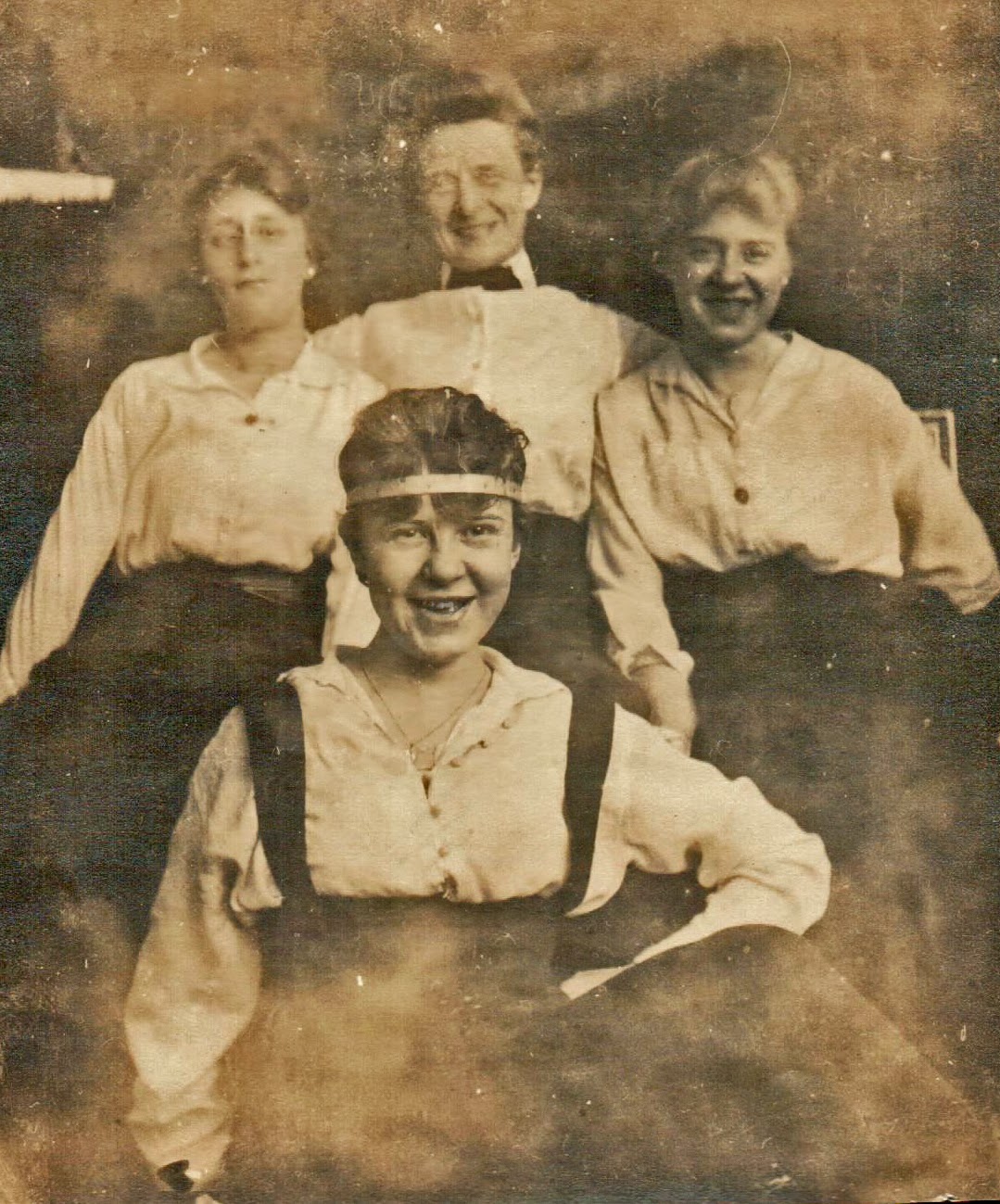
The Maher women, taken about 1918. Roberta is sitting up front on the floor, with her mother behind her.

Tuesday, May 13, 2014

Mothers, Food and Genes

A mother’s diet alters genes
How well a mother eats before conceiving a child can alter her child’s genes. That’s the conclusion of a new study that looked at pregnant women in western Africa—where diets change radically with the seasons—to better understand what factors influence fetal DNA development, LiveScience.com reports. The study involved 84 Gambian women who had conceived at the peak of the rainy season, when more nutrient-packed, leafy green vegetables are consumed, and 83 who’d conceived at the peak of the dry season, when such foods are often scarce. Researchers measured nutrient concentrations in the women’s blood during pregnancy, then analyzed six genes in blood and hair samples taken from their babies. The infants conceived during rainy season had consistently higher rates of methylation—changes in DNA that can “silence” the expression of particular genes. Researchers also found that the lower the mother’s body mass index, the more methylation occurred. “Our results represent the first demonstration in humans that a mother’s nutritional well-being at the time of conception can change how her child’s genes will be interpreted, with a lifelong impact,” says study author Branwen Hennig of the London School of Hygiene and Tropical Medicine. But while scientists now know that pre-conception diet has a genetic impact, the functional consequences of the changes in gene behavior remain unknown.

I remember hearing about a study performed in Sweden, I believe, where the dietary intake of fathers impacted the obesity of their sons and grandsons. It was a very controlled group and the researchers studied the boys who developed their sex characteristics during a famine period or a feast period of years; those boys that did not have enough food passed on genes to their sons and grandsons that made them fatter than the boys who developed with plenty of nutrition around.

Pretty amazing what effect we can have on the health of our children as expressed in their genes.

Sunday, May 4, 2014

Europe's Most Fertile Man

What in the world? Again, from The Week Magazine, an article of modest, amusing interest to those of us doing family research. Now, there are other elements to this story other than the questions/problems this would raise for a person building a family tree. On a side note, I remember hearing that something like 15% of people discover during DNA testing that there was a "non-paternal" event in their tree. In other words, someone they thought was a father turns out not to be. That's a larger number than I would have suspected. In this case, it is out in the open, so long as the parents are forthright with their children about their paternity.

Ed Houben is sought after by women all over Europe, said John Laurenson in BBC.com. The Dutch “charitable sperm donor” is prized for his legendary powers of insemination, having fathered a staggering 98 children in the last decade. More unusually, he donates his sperm in the “traditional way”: by forgoing the syringe and having sex with the women—many of whom are married. “Much better chance of conception,” Houben explains. The 44-year-old started donating to sperm banks in 2002, but when the Netherlands banned anonymous sperm donation, he offered his stud services for free online. As requests poured in, Houben began keeping an up-to-date list of his children on his computer. One British couple now awaiting a delivery came to him after several unsuccessful trips to fertility clinics. “They stayed for eight days and—how should I put it correctly?—she and I slept together four times, and after almost 10 years of trying they had their first pregnancy.” The husbands, he says, rarely present a problem. They’re so eager to have a baby that they’re “beyond these feelings of, ‘Ooh, there’s a stranger sleeping with my wife.’” And that’s what it’s all about, Houben insists: the “beautiful hope of creating a new life that will be loved and looked after.”

One would think that these children must be told their parentage, as what would happen should they find each other.... we have seen from previous posts that there are plenty of long lost siblings out there who find one another later in life....

Wednesday, April 30, 2014

Another source reports on Procrastination

At least this teeny blurb more fully reports the research done on twins about procrastination and the reason it may have developed. I took this from the April 25th edition of The Week Magazine.

The science of putting it off
Chronic procrastination can feel like a character flaw, but a new study indicates that rather than lamenting your lack of will power, you can just blame your parents. Researchers at the University of Colorado, Boulder, surveyed pairs of identical and fraternal twins about their tendency to procrastinate and to set and meet goals, and their level of impulsiveness. Identical twins were much more likely to match answers than fraternals, showing that genetics plays a significant role in forming these habits. “Learning more about the underpinnings of procrastination may help develop interventions to prevent it,” study author Daniel Gustavson tells NatureWorldNews​.com. Researchers also believe impulsiveness, which overlaps with procrastination tendencies, may have given our ancestors an evolutionary advantage by helping them focus on day-to-day survival rather than long-term goals. Procrastination could be a by-product of that thinking, showing how behavioral traits that evolved millennia ago can clash with the demands of modern life.


Tuesday, April 29, 2014

Blog with a similar name

As I named my blog I obviously had to find something unique. I did, at least I did with blogspot.... Today I read an entry with a similar name and of course, with the similar name, it had a similar theme. Nancy Humphrey Case wrote about the sale of her family's farm built in 1810 where 10 generations of her family lived. Such good stuff. But it makes me sad. She concludes it's the stories that make it worthwhile, not the things. I have noticed, though, that it's just often the things that make one remember the stories... We don't write these stories down, or think to tell them on a normal Sunday afternoon. I don't have an answer as how to change that.

But please find here Ms. Case's entry about her farm called Cherry Brook. I hope you enjoy it as I did.

Friday, April 25, 2014

Childless by Choice

I made a conscious decision not to have children, but doing the genealogical research does make me sad that I have not made another generation bringing two family histories together. It has also made me contemplate writing the stories of other childless women in my tree. Of course, other than speculating about their lives based on the world events around them, the stories of these women can be rather sparse. It begs the question about my own contributions beyond the creation of future generations.