Showing posts with label grandparents. Show all posts

Tuesday, September 3, 2019

Sleuthing the Kirkpatricks

It has been a very long time since I have posted. I have been researching, but apparently haven't felt like blogging in a long time.

With that being said, I am meeting with a DNA cousin tomorrow and I brought a ton of unlabeled photographs to share with him in the hopes he might recognize some people. I have also been posting photos on the Kirkpatrick Genealogy Facebook page, hoping maybe someone there might know the people. Alas, it seems that there are many Kirkpatricks which came to this country in the mid-1700s, but mine came over in about 1831, and I have yet to meet a Kirkpatrick cousin from that larger group. Whereas my family stayed in Troy, NY, the rest of the Clan seems to have headed south and west.

BUT, the person I am meeting tomorrow is absolutely a Kirkpatrick cousin and from the Troy, NY area. So I know he is family.

I recently had an "aha!" moment when I realized that I recognized a house in the background. Guessing on the children, I assumed the photograph was from 1900 and I looked at the census for that address and sure enough, the people I assumed were in the photograph were all living in the house together at the time.

The first photograph below I know all the people.

Nellie Jane Kirkpatrick Lee with sons Herbert "Herb" and Horace "Harry"

This photograph was labeled - and I do know the house - Kirkpatricks after the porch and fence taken.


And this third photograph was the mystery. But based on the known children above, the 1900 Census, and other photographs of the house, I think this must be Martha Jane Wright Kirkpatrick holding Harry with little Herb standing in front.


As of a few years ago, the house looks like this:


The house has seen some better days.

This was a house in my family for generations. Through the census documents, one can see first that Charles and Nellie Jane lived there with her brother and sister-in-law, and Nellie and Oliver are in and out a couple times, and then Martha Jane's father is there with them for a while before his death, and then Oliver and Nellie raise their children there. Must have been a sad day when the house was sold and Olive moved with her parents Oliver and Nellie to Bronxville, NY.

Saturday, August 20, 2016

A Little Exploration in to Thomas L. Wright

My knowledge of the Civil War is significantly limited. Only as I research family does small snippets come into focus. I am Googling places and battles and maps as I am reading the discombobulated memoirs of Thomas L. Wright. I hadn't realized, for example, that he signed up almost immediately after the shelling of Fort Sumter. Thomas must have felt very strongly about it. The man was a recent immigrant from Northern Ireland. The man was middle aged! (No disrespect intended.) So what was it that he felt strongly about? Keeping the nation together? Or was he more about Civil Rights and the abolition of slavery? What motivated the man?

His memoirs are very discombobulated, but he writes:
From Washington we march on Monday to Brightwood in Md. There we encamped for three weeks. We received orders about 2 o’clock P.M. to march for Bulls run, when within a short distance of that place we met the retreating forces from that disastrous battle. They informed us that the Union forces had met with a serious defeat.  


I know that Thomas registered (is that the right word?) in April 1861. He was mustered in in June 1, 1861, in Troy, NY. Obviously, he made his way with the 30th NY Infantry to Washington, DC. How long did that take? I don't know where Brightwood, Maryland is... but there is a Brightwood neighborhood in DC. And then it seems to be about 13 hours of continuous marching to get to Bull Run, VA.

So, time in upstate NY with his new regiment. A week? That brings us to June 8th or something. Marching to Washington? Wagons? Trains? Trains, probably. (Maybe there will be a clue if I just keep reading.) So, in Washington by the 15th of June? At which point he marches to Brightwood and trains for 3 weeks... That chronology brings us to the first week in July, which makes sense. I wonder why it was important enough to him to mention that orders came at 2 pm? Does that mean they marched through the night?

I took this blurb from here, the website for the Civil War Trust.

Though the Civil War began when Confederate troops shelled Fort Sumter on April 12, 1861, the war didn’t begin in earnest until the Battle of Bull Run, fought in Virginia just miles from Washington DC, on July 21, 1861. Popular fervor led President Lincoln to push a cautious Brigadier General Irvin McDowell, commander of the Union army in Northern Virginia, to attack the Confederate forces commanded by Brigadier General P.G.T. Beauregard, which held a relatively strong position along Bull Run, just northeast of Manassas Junction. The goal was to make quick work of the bulk of the Confederate army, open the way to Richmond, the Confederate capital, and end the war.

The morning of July 21st dawned on two generals planning to outflank their opponent’s left. Hindering the success of the Confederate plan were several communication failures and general lack of coordination between units. McDowell’s forces, on the other had, were hampered by an overly complicated plan that required complex synchronization. Constant and repeated delays on the march and effective scouting by the Confederates gave his movements away, and, worst of all Patterson failed to occupy Johnston’s Confederate forces attention in the west. McDowell’s forces began by shelling the Confederates across Bull Run. Others crossed at Sudley Ford and slowly made their way to attack the Confederate left flank. At the same time as Beauregard sent small detachments to handle what he thought was only a distraction, he also sent a larger contingent to execute flanking a flanking movement of his own on the Union left.

Spectators at Bull RunFighting raged throughout the day as Confederate forces were driven back, despite impressive efforts by Colonel Thomas Jackson to hold important high ground at Henry House Hill, earning him the nom de guerre “Stonewall.” Late in the afternoon, Confederate reinforcements including those arriving by rail from the Shenandoah Valley extended the Confederate line and succeeded in breaking the Union right flank. At the battle’s climax Virginia cavalry under Colonel James Ewell Brown “Jeb” Stuart arrived on the field and charged into a confused mass of New Yorkers, sending them fleetly to the rear. The Federal retreat rapidly deteriorated as narrow bridges, overturned wagons, and heavy artillery fire added to the confusion. The calamitous retreat was further impeded by the hordes of fleeing onlookers who had come down from Washington to enjoy the spectacle. Although victorious, Confederate forces were too disorganized to pursue. By July 22, the shattered Union army reached the safety of Washington. The Battle of Bull Run convinced the Lincoln administration and the North that the Civil War would be a long and costly affair. McDowell was relieved of command of the Union army and replaced by Maj. Gen. George B. McClellan, who set about reorganizing and training the troops.

I guess we know that the 30th NY Regiment was not the New Yorkers mentioned above.... And the safety of Washington, is that Arlington Heghts, mentioned by Thomas?

Thursday, July 28, 2016

Brick Wall comes down - Anna Brechbill

I found the name of a second great grandmother of my husband's - Anna Brechbill. Unfortunately, no other little leaves are shaking at me, but a name! A family! And it is an unusual name! She shows up on the death certificates of three of her children.

I guess this will take a little more digging and not a passive receipt of information. Shoot. Eventually I need to get myself to Western Pennsylvania to do the original research.

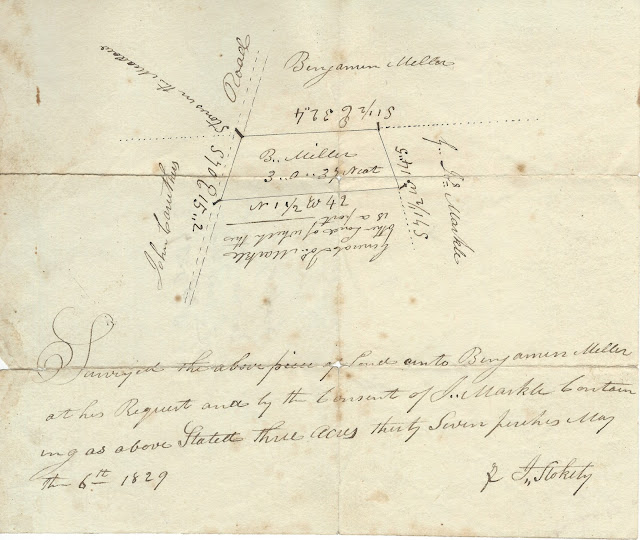
I did discover - or should I say rediscover - an 1829 survey among mu husband's papers. It has a name on it - Benjamin Miller - though I have not connected *that* name to the tree. John A. Miller, yes, so I am assuming Benjamin is a father or grandfather, but I don't yet know. I mean, why else would my husband have that survey if it weren't a family member. I have several deeds and sales receipts for land owned by the family over time.

The daughter of John A Miller, Lucy Miller, married Thomas Robertson and died young, before her father. I lucked out and found a Will for John A. Miller and he names his children and grandchildren, of which one is my husband's grandfather. Such good stuff!

Friday, May 6, 2016

1919 May Report

And here we are... Gone from France and finding our way back to American soil. Herb and his section leave France on May 7th and arrive in the US on the 19th, having sailed on the USS Rhode Island. You can read about the USS Rhode Island here. I took the following photograph from that wikipedia site.


It is fun to see Herb's handwriting on this final report... back to handwritten forms, no longer typed.


Saturday, February 20, 2016

Demobilization Memo #2


And there he is, standing there wearing the same thing as every other man waiting to go home.


Monday, January 18, 2016

Herb's Christmas Eve

Poor Herb - no Christmas package and feeling really low.

I have decided Marnie is Margaret, Herb's youngest sister.

This would be 'Marnie' and Herb in 1953 at Christmas

And this is Christmas 1959 - Harry with his back to us, Dorothy - Herb's second wife on the left - Ruth - Harry's wife - and Nellie Jane and Olive at the head of the holiday table.


On Christmas Eve, what Nellie Jane and Oliver are reading at home and Herb is writing in Luxembourg. Taken from Newspapers.com


Christmas Eve
Dearest Mother + Dad,
How I wish I might have been with you to-night, even for a few hours. But one can’t bridge thirty-five hundred miles except in imagination so I must be content with that.

Who is trimming Marnie’s Christmas tree, thereby taking my job away from me? And where are you putting it? In the same place? This afternoon while I was out for a walk I met a man bringing home whole load of small Christmas trees in a cart drawn by one ox and two milch cows. The poor cows don’t get much rest around here. Many of the peasants have to use them to do their plowing and carting nowadays.

Dec. 26th
My intentions were good night before last but after I started I got to feeling so low in spirits that I couldn’t go on. Lord I was homesick. I wasn’t the only one, either. So the evening ended by we non coms playing cards to keep our minds off our troubles.

Christmas wasn’t a howling success either. We had a good dinner but that doesn’t make a Christmas. At first we were to have turkey but the turkey didn’t arrive so we bought a pig from one of the peasants and half of it made a good dinner for the whole section. With it we had fried potatoes, canned peas, and apple sauce and for dessert apple pie, cheese, nuts + raisins.

The day before Christmas a box came for the Section from the Red Cross. In it was a phonograph with twenty records and a raft of cigarettes. In addition everyone had chocolate + tobacco from the Y.M.C.A. Some six or seven of the boys had received their Christmas packages. The rest are presumably hanging around in some base port. However it’s forbidden to criticize the government or it’s servants any way. They can’t prevent one from thinking, though.

Nothing new occurs. I expect that we’ll move to some other town in Luxembourg, further south, in a few days, but where we’ll go from there I have no slightest idea.

The papers have no news except long detailed descriptions of what the President + Mrs. Wilson wear, eat, visit and talk about day by day. That sort of thing may be interesting to both French and Americans at present in Paris but there’s only one interesting topic amongst Americans in the armies of occupation: That is “when do we get out of here?”

The weather has been colder lately and there was a fall of three or four inches of snow for Christmas.

The rest of the news is that I am well and as happy probably as could be reasonably expected.

And, oh yes, I got those socks you sent me. That’s a good scheme + might be pushed further.

With best love to all,
Your affectionate son,
Herb

Friday, December 18, 2015

1918 December report

Herb got a promotion! Herb got a promotion! Now he is a Corporal. Only one in the unit. I'm so proud.


Saturday, August 1, 2015

Exciting Breakthru

Life is good.

I was contacted by a cousin by marriage through wikitree yesterday. Though I learned I have missed the opportunity to speak with a relative who loved to talk about the Maher family, I have gained some information about a branch of my tree which had grown cold. And I have learned where many relatives are buried.

I have made some speculative stories about my great Aunts, Lillian and Roberta.

I have also come up with a theory about how Florence and Herb met; something I now must explore. I will share more as I uncover, but I have always been confused as to what happened to Karolyn and how/when Herb meets my grandmother Florence. There is a Lee in the Maher plot. Might Herb have visited a Lee relative for a holiday event and met Florence there? Could be. I mean, Herb didn't meet Florence in a bar or on-line.... so how did they meet? A family gathering would be very appropriate. Herb was living in New York City without the rest of his family who were in Troy, NY. Of course, this Lee in the Maher burial plot has not yet shown up in my tree... but maybe a little more digging and time will tell.

Thursday, July 9, 2015

Hanimeli Kapadokya Restaurant, Mustafapaşa, Turkey - A Review

What a fun experience to be in someone's home and have someone personally teach you to make the indigenous cuisine. Even my husband was delighted with the experience - and he does not cook. (He does enjoy eating well, though!)


Perhaps we helped make tomorrow's dolmas for the restaurant... if they were well made, at least. (Perhaps the ones I made went to the family's dinner....)

On a genealogical note, my friend indicated I was a natural at rolling the grape leaves.... we decided it was because I have a great, great grandfather on the Kirkpatrick side who was a cigar maker in the 1800s. I somehow acquired the skill. :)

After learning we enjoyed a wonderful lunch on the terrace. I would recommend this restaurant/home to other visitors if they feel comfortable.

BTW, we learned that the owners were a family effected by the 'population exchange' in the 1920s. You can learn more about this event in Turkish and Greek history here. The upheaval is pretty incredible to contemplate, and I don't think I had ever heard about it until this trip.

Our delightful hostess

Friday, July 3, 2015

Tying my trip to Turkey with Herb's Life in WWI

I had to post twice today to capture both the events happening on 7/3...

On July 3rd, when the Commanding Officer is writing his letter to the Chief of Service U.S.A.A.S. with French Army about the Ambulance Corps, the Sultan, fighting on the side of the Germans, was dying.

I took this blurb from the History Channel's web site for this day.

On this day in 1918, with Turkish forces in the final months of fighting against the Allied powers during World War I, Mohammed V, sultan of the Ottoman Empire, dies at the age of 73.

Born in 1844 in Constantinople, Mohammed ascended to the throne in 1909 after the forced abdication of his elder brother, Abdul Hamid, under pressure from the Committee of Union and Progress (CUP), a rising political party known as the Young Turkey Party, or the Young Turks. Bent on modernizing the fading Ottoman Empire and stopping European powers from taking Ottoman territory, the Young Turks fomented a rebellion within the Ottoman Third Army in 1908 and forced the sultan to meet their demands and restore the Turkish constitution. The army, under the leadership of Mustafa Kemal (later known as Ataturk, he became the first president of Turkey) consolidated power for the CUP the following year, forcing the sultan to abdicate in favor of his brother Mohammed.

The leaders of the CUP, particularly Enver Pasha, effectively dictated the course of events over the next decade, as the new sultan, a gentle man, was little able to exert much of his own will on the throne. The results were not good for the empire: over the course of 1912-13, it lost virtually all of its remaining European territory during the two Balkan Wars and an unsuccessful war with Italy over Tripoli. In November 1914, Turkey entered the First World War on the side of the Central Powers, Germany and Austria-Hungary, against Britain, France and Russia. Though he had initially opposed his country’s participation in the war, Sultan Mohammed now exhorted his army–as well as all Muslims, including those living in Allied countries–to fight exhaustively against the empire’s enemies, proclaiming that “Right and loyalty are on our side, and hatred and tyranny on the side of our enemies, and therefore there is no doubt that the Divine help and assistance of the just God and the moral support of our glorious Prophet will be on our side to encourage us. I feel convinced that from this struggle we shall emerge as an empire that has made good the losses of the past and is once more glorious and powerful.”

By the time Mohammed V died, on July 3, 1918, Turkish forces had endured nearly four exhausting years of war, including a full-scale Allied land invasion of the Gallipoli Peninsula and aggressive Allied incursions into Mesopotamia, and were teetering on the brink of defeat. Within six months of the sultan’s death (he was succeeded by his brother, Mohammed VI), Constantinople itself was occupied by the Allies, and the once-great Ottoman Empire was in shambles.

On our second to last day in Istanbul, I went to the Pera Palace Hotel and viewed the room which Mustafa Kemal Ataturk used. Here is a photo I took of him as a young man. (Talk about a nice looking man...)


Assessment of the Ambulance Corps by the Commanding Officer

So much time has passed between my reports on Herb. I have lost a train of thought, I am afraid.

I missed posting this letter from July 3, 1918 I have in my possession from the National Archive in College Park, Maryland. Though I missed it chronologically with Herb's letters, at least I managed to post it 97 years to the day after it was written!

I have left it large so that it can be read. It gives a good summary of the performance of the Ambulance Division in France up to this point. Our last update about Herb can be found here. From that report it is easier to go back and see some of the other information from around this time.

Very powerful stuff, these statistics. And the battle of the Marne actually hasn't happened upon the writing of this letter.

Tuesday, June 30, 2015

Redoubled Energy (Back with Herb in France)

It's interesting to think about Herb's comment about keeping the war effort going at top speed at home. I am certain he is not referencing what is going through my head... What I think about is food production. I read that the reason we have so many food companies was because during WW2 we had to ship a lot of food to our soldiers and the food had to survive the trip - hence preservatives. And also, once those companies existed, they needed to continue after the war for the jobs they created, so rather than to make women's lives easier with Rice-a-Roni, the reason we have all these manufactured-food companies was to keep the jobs and the assets at work. Scary thought, isn't it? I mean, one can see the logic of the reasoning, but crap, at the expense of our health and family life.

Which of course leads to the next subject which I will not discuss here, but all the technological advances because of war and military.

Anyway... on to different subjects:
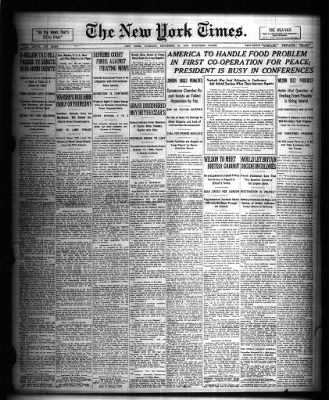
Here is the front page of the New York Times as Herb is writing this letter home:


I'm afraid I don't know who Miss McElwee is. The quickest of searches in Ancestry.com didn't find anything.

Chas is Herb's cousin.

Herb's maternal aunt lives in Huntingdon, NY - it's actually Chas' mother who Nellie Jane is going to visit.

August 25 (1918)
Dear Mother,
I had Dad’s letter of July 28 as well as yours yesterday – the first in a week or so.

We’re still taking things easy – though I expect our time is getting pretty short now. We’ve been in rest billets now almost two weeks. The past week has been very hot and close up till yesterday when a good hard rain cooled things off a bit. However it’s been good harvesting weather and the farm people – they’re old men, boys, women and men not fit for service over here – are very busy from early morning till dark getting in grain.

The war news grows steadily better as you know. I’ve seen accounts of wild celebrating in the States over the American’s victory on the Marne. I think people might better save their breath to keep war work at top speed myself. There is no doubt that the Allied machine is steadily growing and will before long be irresistible but the proper time to shout is after the crossing of the Rhine. This is the time or the folks at home to put their shoulders to the wheel with redoubled energy. The wheel has started, right enough, but it’s going to take lots of more pushing to keep increasing its speed.

I was much interested to hear that Miss McElwee had been working at 14 Wall. Are you sure it wasn’t before I left. I was in and out of there quite often and it would seem as if I should have seen at some time or other.

I wish to Pete Chas would write to me, I haven’t had a letter from him in a couple of months or so.

I expect that by now or in a few days at least you will be in Huntingdon. I’d like to be with you. The Sound is such a wonderful place these days.

The last drafts must have taken a good many of the boys around town. It may be that Stan Kling is over here now. I’ve known cases where things moved as fast as that. Wends must be rather deserted these days.

We’re still with the same Division of French. Of course I can’t name it but I can tell you that it’s rather famous and is largely composed of Chasseurs – those smallish chaps in dark blue uniforms and as good as fighting men as there are anywhere. I couldn’t tell you at the time but I think I can now that we were in the thick of it when the Germans advanced across the Marne. It was a very uncomfortable week because we were all running around like mad all over and had the Germans always on our heels. It took about a week to locate all the men and cars and get them together. They were scattered all over the salient (?). Well, the Germans went back faster than they came in so we were revenged, though I should have liked to have been there to see it.

The hot weather made me a bit sick to my stomach for a day or two but that’s over with and I’m feeling very fit.

A few nights ago we celebrated our vacation with a big dinner – quite a nice dinner, too – and a sort of party afterwards. Everyone seemed to enjoy himself.

Your affectionate son,
Herb

Thursday, May 28, 2015

100th grandchild

Holy Christmas - can one believe this? 12 children, 53 grandchildren, 45 great grandchildren and 1 great-great grandchild. Can you imagine, dear reader, doing the tree for this family? One doesn't have enough space on the screen!

Here is the photo of the proud grandparents taken from US Weekly's web site.


Can you imagine trying to remember all the birthdays, anniversaries, etc? I wonder how many twins there are, or how many folks celebrate the same day as a birthday.

Wednesday, April 22, 2015

Falling soda sales: Not a trend, but a fundamental shift

And then we have this, so I should be hopeful for the health of my fellow Americans. Nice to hear after this previous blog post.


Coca-Cola and Pepsico must be judged not on whether they can resurrect their flagship brands, but on how well they can manage those brands’ decline.

FORTUNE — Soft-drink sales have been declining for nine straight years. This is much more than a trend — it’s a fundamental shift in consumer tastes that poses a major problem for soda makers, no matter how diversified their product portfolios might be.

The latest numbers are astonishing, but not surprising. Sales of soda fell 3% by volume in 2013, to the lowest levels since 1995, according to a report from Beverage Digest issued on Monday. That would be a big drop no matter what, but it’s also more than double 2012’s decline. People are moving away from soda at an accelerating rate.

At this point, companies like Coca-Cola KO -0.74% and Pepsico PEP -0.66% must be judged not on what they’re doing to save their flagship brands, but on how well they’re managing those brands’ decline. Of course that’s not easy for companies that are named for those very brands, so they’re still going nuts trying to figure out how to at least staunch the losses, even as they wisely continue to invest in alternatives like energy drinks, sports drinks, and flavored water

Among many other initiatives, Pepsico tried a new bottle design for Pepsi, and it signed Beyoncé to a $50 million endorsement deal. Coke hired clothier Marc Jacobs as its “creative director.” Sales have continued to plummet.

And the hoped-for savior of the business — diet drinks with artificial sweeteners — are no help. Up until a few years ago, sales of diet sodas were falling at about the same rate as the sugar-filled ones. Now they’re actually falling faster as consumers continue to hear about health concerns. Just yesterday, a study was released indicating that consumption of diet soda can increase the risk of cardiovascular disease in older women.

But health concerns are not the only problem. If they were, it would seem unlikely that energy drinks, sports beverages, coffee-based beverages, and flavored waters would be taking up the slack. But they are. That’s a further indication that what’s doing soda in is the proliferation of choices in the beverage aisle, especially those aimed at young people, an increasing number of whom think of Coke, Dr. Pepper, Sprite, and Pepsi — Beyoncé notwithstanding — as the stuff their grandparents drank in the olden days.

by Dan Mitchell @thefoodeconomy APRIL 1, 2014, 6:38 PM EDT

Saturday, April 11, 2015

Germans Retreat....

Here is the front page from the NY Times from the day Herb is writing this letter home:


Pretty funny that he is claiming that things are quiet - one wonders which war he was involved in!

How astute of Herb about sizing up the (perhaps stereo-typic, though there is always a grain of truth in those...) French character!

What trouble is Harry in now? My goodness that boy!

The kids, of course, are Olive and Margaret.

Section 580 of the Ambulance Corps is still in Suippes, France at this time.

Though it is quiet for Herb when he writes this letter home, in 4 days time
the Allies launch a series of offensive operations against German positions on the Western Front during World War I with a punishing attack at Amiens, on the Somme River in northwestern France.

After heavy casualties incurred during their ambitious spring 1918 offensive, the bulk of the German army was exhausted, and its morale was rapidly disintegrating amid a lack of supplies and the spreading influenza epidemic. Some of its commanders believed that the tide was turning irrevocably in favor of Germany’s enemies; as one of them, Crown Prince Rupprecht, wrote on July 20, “We stand at the turning point of the war: what I expected first for the autumn, the necessity to go over to the defensive, is already on us, and in addition all the gains which we made in the spring—such as they were—have been lost again.” Still, Erich Ludendorff, the German commander in chief, refused to accept this reality and rejected the advice of his senior commanders to pull back or begin negotiations.

Meanwhile, the Allies prepared for the war to stretch into 1919, not realizing victory was possible so soon. Thus, at a conference of national army commanders on July 24, Allied generalissimo Ferdinand Foch rejected the idea of a single decisive blow against the Germans, favoring instead a series of limited attacks in quick succession aimed at liberating the vital railway lines around Paris and diverting the attention and resources of the enemy rapidly from one spot to another. According to Foch: “These movements should be exacted with such rapidity as to inflict upon the enemy a succession of blows….These actions must succeed each other at brief intervals, so as to embarrass the enemy in the utilization of his reserves and not allow him sufficient time to fill up his units.” The national commanders—John J. Pershing of the United States, Philippe Petain of France and Sir Douglas Haig of Britain—willingly went along with this strategy, which effectively allowed each army to act as its own entity, striking smaller individual blows to the Germans instead of joining together in one massive coordinated attack.

Haig’s part of the plan called for a limited offensive at Amiens, on the Somme River, aimed at counteracting a German victory there the previous March and capturing the Amiens railway line stretching between Mericourt and Hangest. The British attack, begun on the morning August 8, 1918, was led by the British 4th Army under the command of Sir Henry Rawlinson. The German defensive positions at Amiens were guarded by 20,000 men; they were outnumbered six to one by advancing Allied forces. The British—well assisted by Australian and Canadian divisions—employed some 400 tanks in the attack, along with over 2,000 artillery pieces and 800 aircraft.

By the end of August 8—dubbed “the black day of the German army” by Ludendorff—the Allies had penetrated German lines around the Somme with a gap some 15 miles long. Of the 27, 000 German casualties on August 8, an unprecedented proportion—12,000—had surrendered to the enemy. Though the Allies at Amiens failed to continue their impressive success in the days following August 8, the damage had been done. “We have reached the limits of our capacity,” Kaiser Wilhelm II told Ludendorff on that “black day.” “The war must be ended.” The kaiser agreed, however, that this end could not come until Germany was again making progress on the battlefield, so that there would be at least some bargaining room. Even faced with the momentum of the Allied summer offensive—later known as the Hundred Days Offensive—the front lines of the German army continued to fight on into the final months of the war, despite being plagued by disorder and desertion within its troops and rebellion on the home front.

August 4th (1918)
Dear Mother,
I’ve had a regular flood of mail this week – about ten letters and two packages of Times and Posts. I like those clippings – they keep me up with the news and the Times is the best paper to clip.

I have just written to Renwick Fleming again since he didn’t get my first letter.

Things are still quiet here-abouts – that is there have been no sizeable attacks. Of course there’s been the usual shelling. The weather is pretty rainy and disagreeable.

I went with the truck today to get supplies from an American Commissary Depot some ways back. We got a good stock of cigarettes and I have some tobacco so I’m on Easy Street. The American Red Cross has made arrangements to send us a supply every month because we’re not in touch with the American depots – that comes free of course.

Hasn’t there been rejoicing in the States over the news of the past week or so. The American troops are certainly coming through. Furthermore there are lots of them. The French are perking up and even are beginning to think of the end of it all – something unusual for them. Usually they just plug along without speculating as to when it will be over.

Is that trouble of Harry’s at all serious or will it only need a little treatment. It’s probably a good things it was discovered.

I could guess of course that the kids were getting pretty big but I can’t imagine Olive as almost as big as you. I wish I could see you all.
Your affectionate son,
Herb

Wednesday, February 25, 2015

Herb's birthday

Dang - to think that my great grandmother couldn't vote... not until 1920. So Herb is indicating that his father and his brother are the two votes in the family as Herb is overseas fighting.

I wasn't able to find anything on Willie Heart.

Olive is Herb's younger sister, and I now believe Marnie is Margaret. Margaret must be 7 years old.

I figured I should include a photo of Herb, in honor of his birthday in our series of letters:


This photo was taken in 1926 - so at this time he is home with a daughter. (And, NO! he is not married to Karolyn, he is married to Florence and I have no idea when they met, or what happened to Karolyn!) Handsome looking dude, wouldn't you say?

July 7, 1918
Dearest Mother,

This is a very special occasion today – not only Sunday, but my birthday as well – the second in the Service and I hope the last. I should have liked to have gone to church, but there is no church for Protestants.

The mail has been pretty backward so I have looked in vain. For word from you or for the packages that Dad had sent to me. That probably means that I’m due for a lot all in one bunch in a few days or so.

The weather is very fine and gives promise of staying so, warm but not too warm, and fair practically all the time now.

Lots of American troops have been coming up in to our Sector the past week. It certainly seems good to see them – that is to us, I don’t believe it pleases Jerry very much.

For three or four days we had an American band in the village and every evening we had a concert. It did sound good to hear real American music. However they went away the night before the 4th.

I have just been writing to Charlie and am going to write the Shermans in a day or two. I wrote Tom, as perhaps I told you, but haven’t heard from him yet. It’s pretty soon to be expecting a reply anyway.

We get a couple of English papers every day, so I manage to keep up with the news now. On the hole it’s very satisfactory, I think.

My own birthday brought to my mind the fact that Harry must be nineteen and that the kids must be rapidly growing up. And yet I can remember Harry toddling around the back yard and crying because Mr. Merrill’s dog had knocked him down.

The papers speak of Willie Heart’s determination to run for Governor. I think he has an unprecedented gall, but then, he’s had that a long time. I’d like to be home to vote. However, we have two votes in the family anyway, haven’t we?

Whenever [sic] you get that money I’ve allotted to you out of my pay, please let me know. Don’t worry about it if it doesn’t come, though, because those things often take several months. If you need it, use it, but if you don’t, put it in the bank.

Ask Olive to write me, Mother, I’d love to have her. And Marnie, too, those queer scrawls of hers are awfully amusing.
Your affectionate son,
Herb

Tuesday, February 24, 2015

"Kids" old enough to be drafted

Tom is, of course, Tom Nial.

Will Groesbeck is another cousin....2nd cousin to Herb, through the Kirkpatricks. Seems William's father died in 1916, so William was taking care of his mother and sisters - at least that is what is written on his draft card. By 1920, though, he is married. It seems he was working at the Watervliet Arsenal.... I suppose that might be the same Arsenal that Herb talks about for his brother Harry. I suppose Cousin William was doing his part for the war effort by being a machinist at the Arsenal.


I still don't know who the Whites are.... Friends from Troy, certainly. (I have been researching my German heritage and that has been taking up a ton of my time... No excuses, but that's my excuse. Hopefully I will write a bit about them some time soon.)

Mr. Friedman is Herb's former supervisor at Case Pomeroy on Wall Street.

Makes me smile to know that Herb liked Rag Time music, but sorry that he is feeling melancholy due to homesickness. Poor Herb.


June 30, 1918
Dearest Mother,

News are scarce as usual. I got your letter written June 10th to-day – a pretty good record.

Those clippings of the open draft quotas were certainly revelations. I noticed the names of so many “kids” I had known. It took me several minutes to realize that they are all old enough to be vote [sic]. I must be growing older myself.

The package Dad had sent for me hasn’t shown up yet. I’ll let you know as soon as it does. It was mighty good of him to go to all that trouble.

A whole gang of Americans came in here last night. It certainly seems good to see them. There was a regimental band with them and we’ve been promised some real American rag time this evening.

I was glad to hear from you that Tom seems to be getting along nicely. I’ve written him.

Did I tell you that had a very nice letter from Mr. Friedman and one from Mrs. Friedman too. He writes that he expects to be over here in the fall but doesn’t say in what capacity.

By the way, how does Will Groesbeck stay out of the draft?

The Whites are certainly in it pretty deep aren’t they [sic]. Still, it’s something that can’t be helped and I know Mrs. White would rather have it that way than to have all the boys ducking it. She’s a fine woman.

Your affectionate son,
Herb

Monday, February 23, 2015

Promotion to private first class

Hmmm. I don't recall Herb mentioning this to his parents, but back in February of 1918 he was promoted to a private first class. Uh-oh, those to-be missing colleagues were also promoted at the same time - Arthur K. Drake and Russell C. Harrison.


What was he doing at this time? I guess he was moving up to the front.... and still in a French Camp.

To my readers, if you wouldn't mind saying hello, I'd love to hear from you. Please leave a comment on this post or any other. Best, Alexandra

Sunday, February 22, 2015

Furloughs have started...

According to the History Channel nothing of import is going on the week of June 23rd in 1918.

June 23, 1918
Dear Mother,
I rather expected a letter from you this week but the mail man comes empty-handed every day.

There’s nothing new around here. The sector continues very quiet – for which I’m not a bit sorry. The weather is clear enough but quite cool – much cooler than it is at home this time of year.

Friday marked the end of a year in the army for most of the Section so we celebrated with an extra-good dinner and a sort of party afterwards. I didn’t enjoy the party much myself because it made me think of the ones the gang used to have at school and likewise those we used to have at 193 Sterling Place, sometimes in the evening.

Our permissions, or furloughs, have started, though I don’t know just when mine will come. We get seven days, exclusive of travelling time, which makes a nice little vacation.

Somehow I can’t think of anything to write that will get by the censor. Keep me posted as to how Harry is making out. I’m interested.
Love,
Herb

Saturday, February 21, 2015

Don’t worry. I’ve never felt better in my life.

Helen is Herb's first cousin, daughter to Uncle Will and Aunt Ada. We have some photos here.
Olive and Marnie are Herb's younger sisters, though I am still sorting through the nickname Marnie. I always knew her as Margaret.

From June 14th to July 15th, Herb is in Bussy le Chateau, Marne.


June 18th, (1918)
Dear Mother,

Everything is fine. We’re back on the line again – on active duty. I mean rather because this base is quite a ways back of the lines, even further than the place where we were first off – several months ago. The sector is very quiet. I hope it continues so because these sturing ? times are very hard on one’s nerves. We have very good barracks and are very comfortable, taking it all together. The weather’s been rather rainy lately – though not too rainy, and altogether I think the weather is cooler than it is at home.

I was much pleased to hear of Harry’s good luck in getting a good place and I do hope that he’ll be able to come through. I know he will if it can reasonably be expected of any one of his age and experience. The kid merely has backbone to go trailing down there there [sic] all on his own and I know he’ll do his darnedest. His only trouble is that he doesn’t say enough about himself. If he’d only loosen up and tell his troubles occasionally he’d be much better off. Tell him to be sure + keep in touch with Chas. I know that Chas will do everything he can for him, when he knows it’s the right thing to do, and I’m sure he can give Harry a lot of darned good advice if he’ll only go to him when he’s in trouble. Chas has been through the mill + and he knows what’s what. I hope Miss Pearsall can take him. I told you last week, did I now that I had had a letter from her.

I had Helen’s letter a few days ago. Tell her I’ll be writing her shortly.

How are the kids, Mother. I’ve been thinking a lot about them lately. Olive, I suppose, will be a young lady when I come back. And Marnie, how I wish I could see her and you all.

Several packages of magazines and things you sent have arrived this week and I’ve had a fine time catching up with current events in the U.S. the general tone of affairs looks better – more determined.

Don’t worry. I’ve never felt better in my life.

Your affectionate son,
Herb

On June 11th, the History Channel tells us this happened:

After several months of an aggressive German offensive on the Western Front during the spring and early summer of 1918, the Allies begin their counterattack, including an assault on June 10, 1918, by four French and two American divisions on German lines near the town of Antheuil-Portes in central France, some 45 miles from Paris.

Code-breaking by French intelligence at the beginning of June 1918 had allowed the Allies to prepare for a German attack in France that was to begin at midnight on June 7. The French launched their own massive artillery bombardment some ten minutes earlier, catching the Germans while they were still preparing for the attack. The Germans countered with an even stronger assault, firing 250,000 rounds of poison gas—including mustard, phosgene and diphenyl-chlorarsine—into the French trenches, incapacitating some 4,000 French soldiers and killing 32.

After three days of battle, the Germans had forced the French back to Antheuil-Portes. Winston Churchill, in Paris at the time coordinating Allied munitions, wrote to his wife on June 10 that "If the French cannot hold [the Germans] back on this sector, it is not easy to see what the next step on our part should be." The following day, four French and two American divisions launched a counterattack aided by significant air support as well as over 150 tanks. They successfully pushed the Germans back from Antheuil, taking more than a thousand German prisoners. A German attack west of Soissons on June 12 made negligible gains, and German Chief of Staff Erich Ludendorff called off the offensive that same day. The Allies continued their push, however, beginning a change of momentum that would gain force throughout the summer of 1918 and the final months of World War I.