Showing posts with label New Orleans. Show all posts

Monday, August 10, 2020

Joseph Moss White and his scandal

Who knows how much of this story is embesllished. It was publised 4 years after the death of said Joseph Moss White. It is a delightfully horrible, or horribly delightful, tale. There is another news story I need to trasscribe which has difference figures - multiplied by ten! So, instead of $45,000, it was $400,000 provided to the young Mr. White. 

I tried to find 40 rues des Cosseles in Paris and no such address - at least not now. 

And Stydd House.... there were references to it on Google, but it wasn't quite clear, so I gave up without more information. 

And what is Colon? I don't know. 

From The Weekly Times-Democrat (New Orleans, Louisiana 26 February 1892) 

GAY LIVES ABROAD 

TWO NEW YORKERS WHO SQUANDERED FORTUNES 

The Rapid Career of Young Joseph Moss White - He was wayward from childhood and left a record in every city in Europe 

New York, February 17th - there have been many rich young New Yorkers who have plunged into gay life in a wholesale manner and cause no end of talk while they were doing it. There was never much talked about the life led in Europe by Joseph Moss White and Harvey Spencer, Jr., And yet it was more extraordinary than that of any other young Americans who have made a stir abroad. Whilel New York heard little of them, their names were familiar in London, Paris, Vienna and even the Far East. A good many years ago Eli White was at the head of a large hat manufacturing establishment in New York. He made money and judiciously invested it in real estate. It was never necessary for his son Joseph Moss White to do any work, and he never did any. He wanted to make a good marriage and he succeeded. He married Matilda Wolfe Bishop, the sister of David Wolfe Bishop and the cousin of Catherine Wolfe. The marriage caused a bitter quarrel between the bride and her family. Joseph Moss White died before the only son of the marriage was born. The son was named after the father and he is the hero of the story. Mrs. White had a considerable fortune in her own name. 


When in his childhood, the posthumous boy was wayward. there was nothing wicked in his nature, but he was always getting into scrapes. He was prepared for Princeton, where he remained about two years. His wildness caused his mother to send him abroad under the care of a tutor, the Rev. Samuel J. McPherson. The young man led the reverend gentleman a mad dance over the continent. While he was abroad Eli White, the grandfather, died, leaving the young man $15,000 which caused surprise. The old gentleman did not like the manner in which the young man had acted. The bulk of the great fortune was divided between his children, John Jay White, who lives at Fifth Avenue and Forty-second Miss Susan White, who lives in Kensington, London, and young White's mother, who received her husband's share. Miss White was fond of the youthful Joseph, she thought he had been unfairly treated, and so she settled $45,000 upon him.


About this time White's chief end in life seemed to be to fall in love with every pretty girl he met. He was usually engaged to three charming young women at one time in his own social circle, besides having many liaisons with women beneath it. He was always bubbling over with animal spirits and wine.


 SPENCER COMES IN.


In 1881, while he was in his uncle's house at Lenox, he met Harvey Spencer, a young man of fine family, fine manners and fine clothes. Spencer belonged to the Spencers of Guilford, Connecticut. When Joseph White met Harvey Spencer the latter was known and every fashionable house in New York. He was said to be the best dancer in society and a thorough man of the world. Two years before he had gone to Hong Kong, China, to make his fortune. He did not make it, but he did lose his health. Spencer and White became fast friends directly. Mr. Bishop encouraged the friendship. One reason was that Spencer's shattered health made it impossible for him to go into excesses. But he could not curb White. The young man contracted a passion for Marion Whitehorn and brandy, which nearly resulted in his ruin. The young woman was extremely pretty and thoroughly bad. White had met her in Crane’s resort in West Thirtieth Street. Her real name was Mary Flenner, and she claimed to be the divorced wife of a gambler. The young woman exercised a powerful influence over White, whose mind and body began to give way because of excessive brandy drinking.


It became necessary to take vigorous measures. Mr. Bishop asked Mr. Spencer if he would not lend his assistance. The first step was to get White away from the woman. The plan agreed upon was virtually a kidnapping. Mr. Bishop wanted to pay all the expenses. White was spirited away to Washington first. It was at times necessary to detain him by force in order to prevent him returning to New York. He was virtually insane. Then the young man was brought to Jersey City, placed on a steam tug and taken to Staten Island, where he was transferred to the steamer Alva bound for Haiti and Colon. In the meantime detectives were searching high and low for White at the insistence of Marion Whitehorn, who claimed that her husband had been kidnapped. At Colon, White and Spencer were met by Allan Pinkerton, the detective, who directed them to sail for England on the steamer Moselle. The vessel put up for a few days at St. Thomas where the voyagers were met by a man named Field, who came at the insistence of the so-called wife. Field interested the United States Consul in the case and managed to see White. The young man wanted to return to the woman, but Spencer managed to get the charge away safely. On the long voyage White was weaned away from brandy, and he began to improve.


The two young men journey through England and the Continent and then went to India and the Far East. They also visited Australia. When White became of age he threw money to the winds. When he was in the clutches of Marion Whitehorn Mr. Bishop induced him to place the principle of his fortune in trust until he was 25, so that it should not be squandered. Subsequently, just before the kidnapping, he signed without reading the document making the trust deed cover his entire life. When the young men started from New York Mr. Bishop agreed to allow them $4,000 a year. This was inadequate. When White improved the whole income was given to him. The legitimate income ranged from $20,000 to $23,000 a year. White had become so attached to Spencer that he proposed that they live together and share the income. They lived at a tremendous rate. In Paris they had a beautifully furnished hotel at No. 40 Rue de Cosseles, and their cook was said to be the best in Paris. They had a fine country place in Hampshire, England, called Stydd House, where they kept eighteen horses and a retinue of servants. They also maintained a sailing yacht and a steam yacht. For the latter they paid $30,000. At a New Year's banquet given in Paris in 1888 White caught a cold, which developed into dry pleurisy. White was seized with a coughing fit, the abscess burst and White died of suffocation. He was then 28 years old. The will provided that all outstanding debts in the names of White and Spencer should be paid out of the estate, and that a sufficient sum should be placed in trust to yield Spencer $10,000 a year. Spencer had the body embalmed, and 10 days later he started with it to America. He was met at the pier by Mr. Bishop, who told him that White’s will was useless, as he had no property to bequeath, having surrendered at all to his mother. Spencer says that Mr. Bishop had the body secretly buried the next morning, without letting him or any of White’s friends know anything about it.


At the time of White’s death there were $45,000 of debts. Of this Spencer claims to have paid off $26,000. Next Friday the case will go on. It is said Spencer will begin a fight to have the will carried out in spite of the release he gave. Counsel for White’s mother says Spencer is unprincipled in his demands for money.


Tuesday, February 13, 2018

Wednesday, April 5, 2017

James Michalopoulos - New Orleans Painter & Sculptor


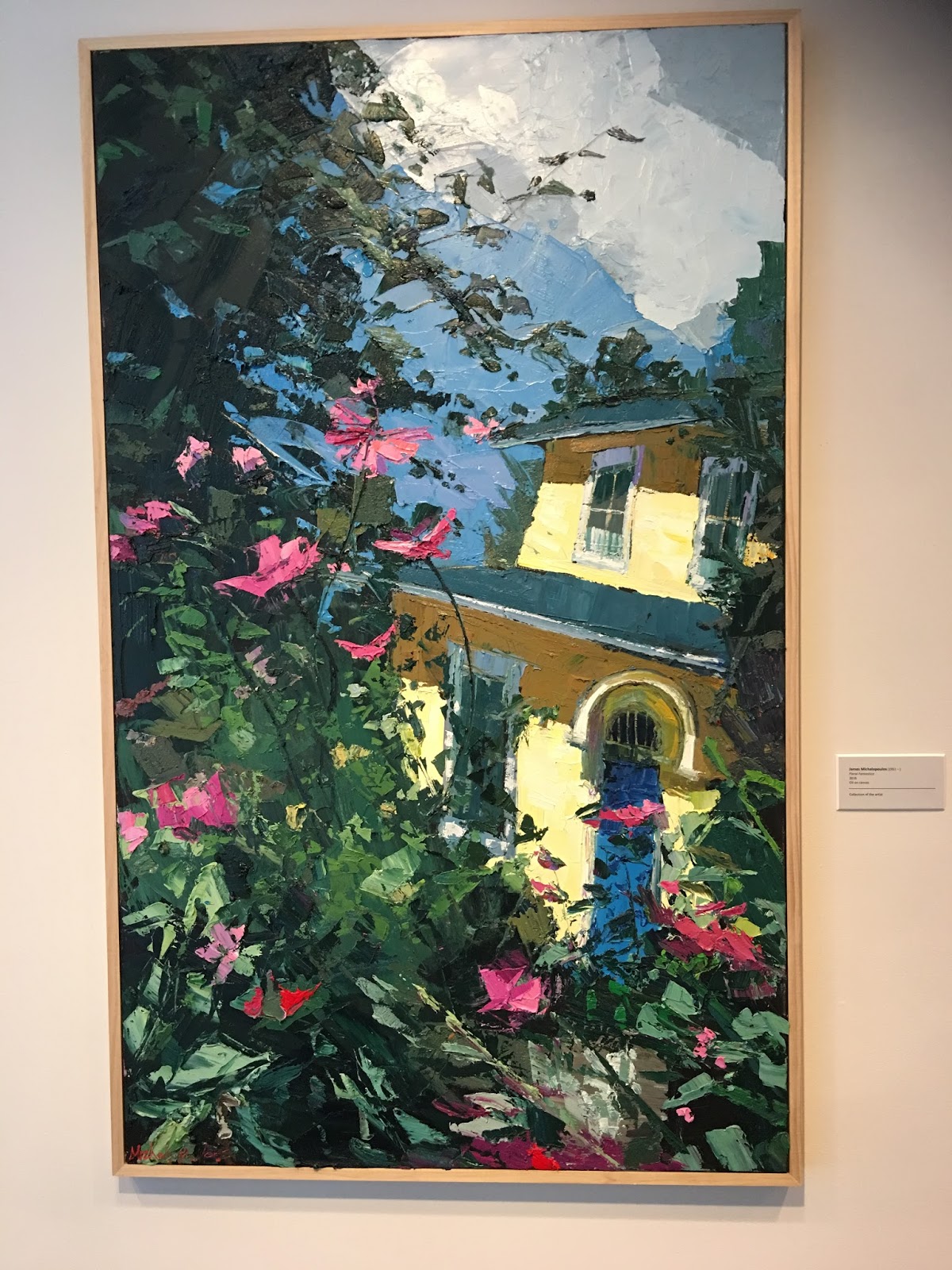
Whoa. Went to hear the artist speak at the Ogden Museum of Southern Art. Mr. Michalopoulos is incredibly prolific and his paintings are fun! I probably respond as I do because in many cases the subject is architecture... and New Orleans architecture to boot. I love the colors and the Dr. Seuss-esque quality to the perspective.

You can find his bio on his website, but I will reproduce here:

Celebrated New Orleans artist James Michalopoulos was born in 1951 in Pittsburgh. After graduating from Bowdoin College with a Bachelor of Arts degree he pursued the life of a modern-day itinerate artist, traveling throughout the South while capturing its unexpected, everyday exotica in his paintings. He eventually settled in New Orleans, drawn to the city that would become his muse. He studied fine art at the New Orleans Academy of Fine Art and at the University of New Orleans. He began painting en plein air in the French Quarter, working in oil on canvas, and became known for his energetically distorted interpretations of vernacular New Orleans buildings. His paintings capture the life, movement and personality of his subjects. His has a uniquely musical, energetic style–full of color and broad brushstrokes. He lays paint on thickly, sculpting the paint with a palette knife until his subject emerges. “My style is an abstraction of the figurative. I like color, volumetric shape and graphic lines. While one may recognize the subject of my painting, through my work one discovers the spirit of it.”

Although he remains inspired by the duality of beauty and decay that is the heart of New Orleans, Michalopoulos’ recent canvases also capture the human form – both in portraiture and social scenes, abstracted landscapes–mostly of the woods and fields surrounding his home in France, and occasionally animals that have managed to catch both his eye and imagination.

His work has been shown extensively in the U.S. and abroad, including: France, England, Germany, Switzerland and Holland. He has been named Official Artist of the New Orleans Jazz & Heritage Festival six times, with his work appearing each time on the coveted poster, an unprecedented, and–to date–unmatched honor. Gambit Weekly has declared him “Best Artist of the Year” eight times. His work has been collected by such distinguished figures as: Jackson Browne, John Goodman, Linda Hamilton, Bonnie Raitt, Sharon Stone, Aaron Neville, Emmylou Harris and Bruce Willis.

Public and corporate collections include: the Ogden Museum of Southern Art, the Governor’s Mansion of Louisiana, Universal Studios, the New Orleans Museum of Art, Chevrolet Motor Corporation, the Chrysler Corporation and Northwest Airlines, among others.

I enjoyed hearing about his process and to hear about the daily life of an artist. Makes one think that everyone can do it, but also understand that it takes some serious commitment and a special life perspective to do it. I envy him.


It appears one can buy some posters or prints of his work... and he is also a very talented sculptor. Very colorful and whimsical.

Friday, March 3, 2017

Good Week for:


Alone time, after an international study found that highly intelligent people tend to be happier when they spend more time alone, working on their goals and interests, and less time socializing with other people.


Hmmm. what does this say about the people in Lafayette, Louisiana? The happiest people in the United States? Just teasing.... I suspect we can possibly assume that the reason to live is to love and be loved, so community is what makes most people happy. And food, let's add food to what makes people happy.... At least for me.

I notice that New Orleans is not on that list... And New York, the most unhappy? Yikes. What does that say about all my ancestors? Guess it's a good thing we left!

Tidbit taken from the December 2, 2016 The Week Magazine.

Sunday, February 19, 2017

Lula Restaurant and Distillery

Cleopatra Queen 2017


On the first night of parades this year - a very wet first night - we ended up in the newly opened Lula Distillery and Restaurant on Saint Charles. By asking our waiter, Byron, some questions about the distillation process, we got a private tour of the distillery guided by one of the owners, Jess Bourgeois. Jess's story can also be found on the Lula web site.

The space is very big - half an event space and half the restaurant and distillery. I wish I had taken photographs... the still is behind glass and is beautifully shiny. Jess probably spent 20 minutes or so with us and walked us through the entire distillation process. I learned on his web site that he attended several courses on distillation, including one at Cornell University. Cornell is big in the wine industry, too, so I recalled fondly a course I took way back when with Dr. Smart when he came out to the Paso Robles wine country in California. I think he was visiting with UC Davis, but I honestly don't recall; it was a long time ago. I liked a trellis system about which he educated us, Smart-Dyson ballerina.

Anyway, a nice respite from the rain at the restaurant. My cucumber collins was quite refreshing. I enjoyed my Creole Slaw salad and the cheeseburger was delicious. I had the boudin egg rolls, too, which I enjoyed, but did need to use the molasses fig sauce to cover up some of the gaminess of the boudin. (Was that liver in there? I know organ meats are rich in nutrients, but I still can only really enjoy foie gras.)

The spirits have not yet been entered into competitions. I think they are still working on the formulas/recipes. The make vodka, gin and rum.

I will happily go again.

Tuesday, August 23, 2016

Another book/story idea...

I started this post back in June while I was reading that book on Race and The Americanization of Louisiana. I was flabbergasted by the idea of kidnapping one's pesky, embarrassing relatives and shipping them off to The New World. One contributor - forgive my lack of reference - indicated that: "By 1719, deportation to Louisiana was considered a convenient way of getting rid of troublesome neighbors or family members " (p. 62)

I thought one might use that scenario as a basis for a pretty interesting story line.

Which of course makes me think about that recent article about there only being 6 different emotional arcs in story lines:
The six basic emotional arcs are these:

A steady, ongoing rise in emotional valence, as in a rags-to-riches story such as Alice’s Adventures Underground by Lewis Carroll. A steady ongoing fall in emotional valence, as in a tragedy such as Romeo and Juliet. A fall then a rise, such as the man-in-a-hole story, discussed by Vonnegut. A rise then a fall, such as the Greek myth of Icarus. Rise-fall-rise, such as Cinderella. Fall-rise-fall, such as Oedipus.


So, what story would we create? I imagine Anne Rice's Interview with the Vampire... Brad Pitt was pesky... and then I imagine a prostitute made good... I imagine these people being second sons of landed gentry... I imagine emptied prisons.... shall we pick a Jean Valjean character and a new story-line? Set with Jazz and oysters? I don't know... a creative individual could come up with something.

Sunday, August 21, 2016

La Crepe Nanou - A little promotion of an adorable restaurant outside of the Quarter

I started this post ages ago, too. Like after dining there... So much for being on the ball. I bring it to you now.

We were delightfully surprised with the find at 1410 Robert Street in New Orleans. We will go back in a New York minute. I have absolutely no recollection of what I ate, but I was delighted. The atmosphere was charming and the service attentive.


La Crêpe Nanou is a romantic neighborhood
French Bistro and Crêperie established in 1983 and voted best French Bistro by New Orleans Magazine.
Our notable menu items include:
Crêpes (savory and sweet!), PEI Moules Frites,
Escargot and Local Whole Grilled Fish, Grilled Lamb Chops
Brunch Highlights: Crêpe Lorraine,
Omelette au Crabe, Croque Monsieur and Madame.
Additionally, we offer vegetarian, dairy-free and
gluten-free choices; as well as numerous Specials du Jour.

Just putting it out in the Universe about this bistro.

Thursday, July 7, 2016

Vicki Lee Fine Art (Another Lee, but not fiber art, either)

I came across Vicki Lee's work at "The Shops at 2011 Magazine". You know I had to promote her because a) I liked what I saw and b) her family name is Lee. A lot like this previous promotion of Victor Lee, who also is not a fiber artist.


I saw some of her encaustic abstract landscape pieces. I can see how they can set a mood in a room.

Given how many places she sells her art, I would suggest that she is a prodigious artist.


Here is what she writes about herself on her web site:
Thank you for viewing my artwork. My paintings express my desire to show a "less serious" side of life. I hope to transport my audience to an interesting and imaginative place where they can dream of future visits or remember the old ones.
Any of the abstract landscapes can be painted with other color palettes and sizes. Please contact me if you would like to view any of the paintings offered.
In New Orleans, my paintings are available for purchase at Estella's Home located on Metairie Road.
In Seagrove Beach, Florida, my paintings are available at Fouquet Design, 3723 E. 30A., Suite 6, Seagrove Beach, Fl., 32459, 850-534-0972 and Beau Interiors, 22 East County Hwy 30A, Grayton Beach, FL.
Thank you,
Vicki Lee


Tuesday, June 14, 2016

Tribes

Sonofabitch, if I wasn't complaining to my friends last night about not being a part of a tribe... (Obviously it has been on my mind after reading that article about the guilds in the June 3rd edition of The Week Magazine.) And then the very next day this review of a new book entitled Tribe comes out printed in the Guardian UK, forwarded to me by the very friend listening to me bitch.

I guess, actually, it has been on my mind for a long time, as researching my German branches I learned that the early German settlers in New York clearly helped one another with organizations and politics. One of my great, great grandfathers was a founder of several banks and insurance companies. There is nothing today that I might rely on... even family is a little too dispersed to be counted on. (And, of course there is this scam among amateur genealogists of people claiming to be your cousin and then asking for financial support.)  

Photo taken from here
During John Ford’s celebrated western film The Searchers, John Wayne’s character spends years hunting for his niece Debbie, kidnapped as a child by Comanche Indians.

When he finally finds her, she initially wants to stay with her Comanche husband rather than return home.

Although shocking in the film, it’s historically accurate. White people captured by American Indians (author Sebastian Junger’s preferred name for Native Americans) commonly chose to stay with their captors - and the book cites a case of a captive woman who hid from her would-be rescuers.

Even more astonishingly, from the earliest days of Europeans in America, settlers of both sexes ran away to join Indian tribes. This wasn’t just a few people, it was hundreds and hundreds. The practice was so rife that in the early 1600s settler leaders made it an offence with harsh punishments, but over the following centuries people still ran off in huge numbers.

And it hardly ever happened the other way. Indians didn’t want to join white society.

The attraction, argues Junger, was the sense of community, the importance of the tribe, evident in other primates and in primitive human societies. The superficial attractions of American Indian life were obvious: sexual mores were more relaxed, clothing was more comfortable, religion less harsh.

But mostly it was the structure of Indian society that appealed. It was less hierarchical, essentially classless and egalitarian. As the people were nomadic, personal property hardly mattered, since it was limited to what you or your horses could carry.

What changed this natural way of living for humans was first agriculture, then industry. Accumulation of personal property led to people doing what they thought best for themselves, rather than for the common good. But, suggests Junger, we’re not happy like this. We’re wired to the lifestyle of the tribe.

Take the London Blitz during World War II. Before it began the government feared there would be riots and maybe even revolution as people fought one another for space in bomb shelters or for food.

In fact, exactly the reverse happened. People from different classes mixed in a way they hadn’t before and joined together in the face of a common enemy.
Historians credit the ‘spirit of the Blitz’ as the cause of the Labour landslide victory in the 1945 election, its strong feeling for community leading to the foundation of the NHS and a robust welfare state.

Those caught up in the bloody conflict in Bosnia often say they were happier during the war. The reason, they say, was they all pulled together, felt connected and part of something bigger than themselves.Junger, an American journalist and former war correspondent, gives many examples of what our modern way of living has cost us. In a modern city or suburb you can go through an entire day meeting only strangers. As affluence and urbanisation rise, rates of suicide and depression go up. According to the World Health Organisation, people in wealthy countries suffer eight times the depression rate of those in poorer ones. But when we revert to the tribe, things improve.

Junger spent time embedded with U.S. troops in Afghanistan, and says he was never alone there. Soldiers slept a dozen to a shelter. You couldn’t stretch out an arm without touching someone. Men of all colours, classes and creeds bonded as they had to look out for one another.

In a tribe the survival of the individual depends upon the survival of the group. The lack of this brotherhood is what makes it so hard for returning combat veterans to reintegrate into contemporary, fragmented societies.Community spirit in the U.S. rocketed after 9/11. The suicide rate dropped dramatically. There were no rampage shootings in public places like schools and colleges for two years.

Interestingly, such shootings happen only in middle-class rural or suburban areas. There has never been one in a poor inner-city location, where gangs provide a tribal sense of belonging.

This sense of bonding with the larger group begins almost at birth. In less developed countries, children sleep with or in close proximity to their parents and often an extended family group.

It’s only in Northern European countries (and the U.S.) that small children sleep alone. It’s only here that they go through a well-known developmental stage of bonding with stuffed animals or so-called ‘comfort’ blankets.

In Junger’s small, but convincingly argued, book he quotes the self-determination theory, the things necessary for contentment. People need to feel competent at what they do. They need to feel authentic in their lives.

Above all, they need to feel connected with others. It’s a good starting point for rethinking the way we live our troubled modern lives.

In the book I mentioned the other day, New Orleans: Race and Americanization, at least one of the essayists mentions how enslaved Africans would flee to the Indigenous Peoples, in this case the Choctaws and the Chickasaws, but it wasn't a matter of "sexual mores were more relaxed, clothing was more comfortable, religion less harsh", obviously.

Here's an update... I was looking back on some old posts and apparently I was bitching about tribes (or not being a part of one) way back in May 2015

Friday, June 10, 2016

Book Idea - Coureurs-de-Bois

I'm reading Creole New Orleans: Race and Americanization edited by Hirsch and Logsdon. I just started it, but so far, very good. It is a series of essays.

The first essay, by Jerah Johnson, mentions coureurs-de-bois, young men/boys who were sent to live among the indigenous peoples in order to learn the language and customs. I should think a novel or story from the perspective of these young men about the formation of current day Louisiana would be good. And vice versa, as young Indian men went to France. (Mostly this trading of young men occurred with the French settlements in Canada.)

Taken from here


The essay has been very helpful to understand the French policy which explains some of the backstory to what we descendants of the English settlements call the French and Indian Wars. I certainly know about them, but never really understood why the French and Indians were fighting together against the British. 

I don't recall the story of The Last of the Mohicans, but I suppose there might be some overlap in the story context, but with an English sensibility, which I believe was markedly different than the French approach to policy in North America.  

Thursday, May 26, 2016

The Health Benefits Of Dancing Go Beyond Exercise And Stress Reducer


What are the health implications of dancing? New social science research shows that dancing in synchrony with others increases people's threshold for dealing with pain. Go here to see/hear the conversation. I don't suppose this is a surprise to anyone - that it's a good thing to do.

I wonder if my husband will take me Zydeco dancing more with this information?

Wednesday, May 18, 2016

Making a flouncy skirt


I bought a very flouncy skirt years ago in Jackson, WY. I never wear it; I paid a lot of money for it. I'm not even sure I love it... I love the idea of it, though. And I have saved it for years just so that I might copy it and make one myself.

I figured the best skirt to make from this skirt would be a Mardi Gras skirt. It's almost costume like, I figured. And it's great skirt to dance in... particularly with my fleur de lis cowboy boots! Of course once I got to the quilting shop I was overwhelmed by all the fabric choices... and then wandered away from the Mardi Gras fabrics. I tried to stay within the Purple, Gold and Green theme, but I wandered away from that, too, I confess. So I am not sure what this skirt is that I am making or when I would wear it. Perhaps when I go Zydeco dancing at the Rock 'n' Bowl. Other dancers would appreciate the Mardi Gras fabric and the wonderful effects the skirt would make when dancing.


I guess I need to work on impulse control. (Story of my life!)

In any event, I have created the first five tiers and I have another three to go. This feels like it has taken a huge amount of fabric - a lot of time gathering the fabric to get smaller and smaller as I go up the skirt to the waist. But really I am using what is known as 'Fat Squares' from the quilt shop. I posted here from my trip to Mes Amis with the fabric I bought for this skirt.

I think rather than just gathering I may have to cut the fabric on an angle to cinch it even more drastically. I will post again on this project as I progress.

Saturday, March 12, 2016

Mes Amis Quilt Shop

I spent a wonderful afternoon with Cathy and Melissa at Mes Amis Quilt Shop in New Orleans. We talked quilts, genealogy, restaurants, history, fashion and a variety of other subjects. I went with the intention of finding Mardi Gras fabric which the web site indicates they carry all year so that I might make myself a skirt for 2017 Mardi Gras.

Here are the fabrics I bought today:


I started with all Mardi Gras themed fabrics and branched out when I didn't like the combinations. Of course after I had picked out my fabrics I turned around and there was a quilt with many of the Mardi Gras fabrics coordinated very nicely.

I ended up buying three yards of the bird fabric... it is a glorious fabric and I thought I might make another skirt or dress.

Friday, February 19, 2016

Michael Meads at the Ogden

Ok, this has nothing to do with travel, health, genealogy or fiber art, I just really liked the exhibit.

I am reporting on this exhibit a little late.... Only there until the 28th of February. You can find info about the Odgen here.

I heard Michael Meads speak about his art and the creative process the other day at the museum. So wonderful to hear an artist talk about their work. He spends a full day on his art - starting at the studio around 9 and ending around 4:30 pm. He says his hand cramps up. The size of his art is dictated by the size of the studio; such practical considerations.

I loved it. Such incredible detail; such beautiful colors, such a variety of media. Boy, though, does he love penises and round bottoms. For an example of his very colorful watercolors, go here.

Here is the blurb from the Ogden:


Here is an example of his work taken from his web site:

Thursday, January 21, 2016

Clara Lazzaretti and Alexandre Bienvenue

I spent much of the day at the notarial archives in NOLA researching some properties. Mostly I was overwhelmed, but I learned a few things and met some very nice people - including stunningly beautiful Tabitha who is headed off to graduate school in conservation soon, she hopes. I met Erin and Natalie, too, who helped me understand a bit about how to go about getting information, and Leslie (or Melissa?) who spent a lot of time with me educating me about the work that some Tulane students did entering the buildings of French Quarter into a wonderful database. The property I was researching, unfortunately lies directly across North Rampart, so it was not included in their wonderful database.

I did, however, find these maps:


This map seems to show the division of Mr. Treme's property into lots. It appears to me that this map was created by Jacques Tanesse on June 13, 1810. Mr. Treme seems to have owned the house and orchard in the upper right hand area. I took this map from here.

I also found this funny map. The reason it interested me and I saved it because it mentions the name Alexandre Bienvenue, who is Clara Lazzaretti's brother-in-law and the person from whom she buys a property on North Rampart designated as No. 25.


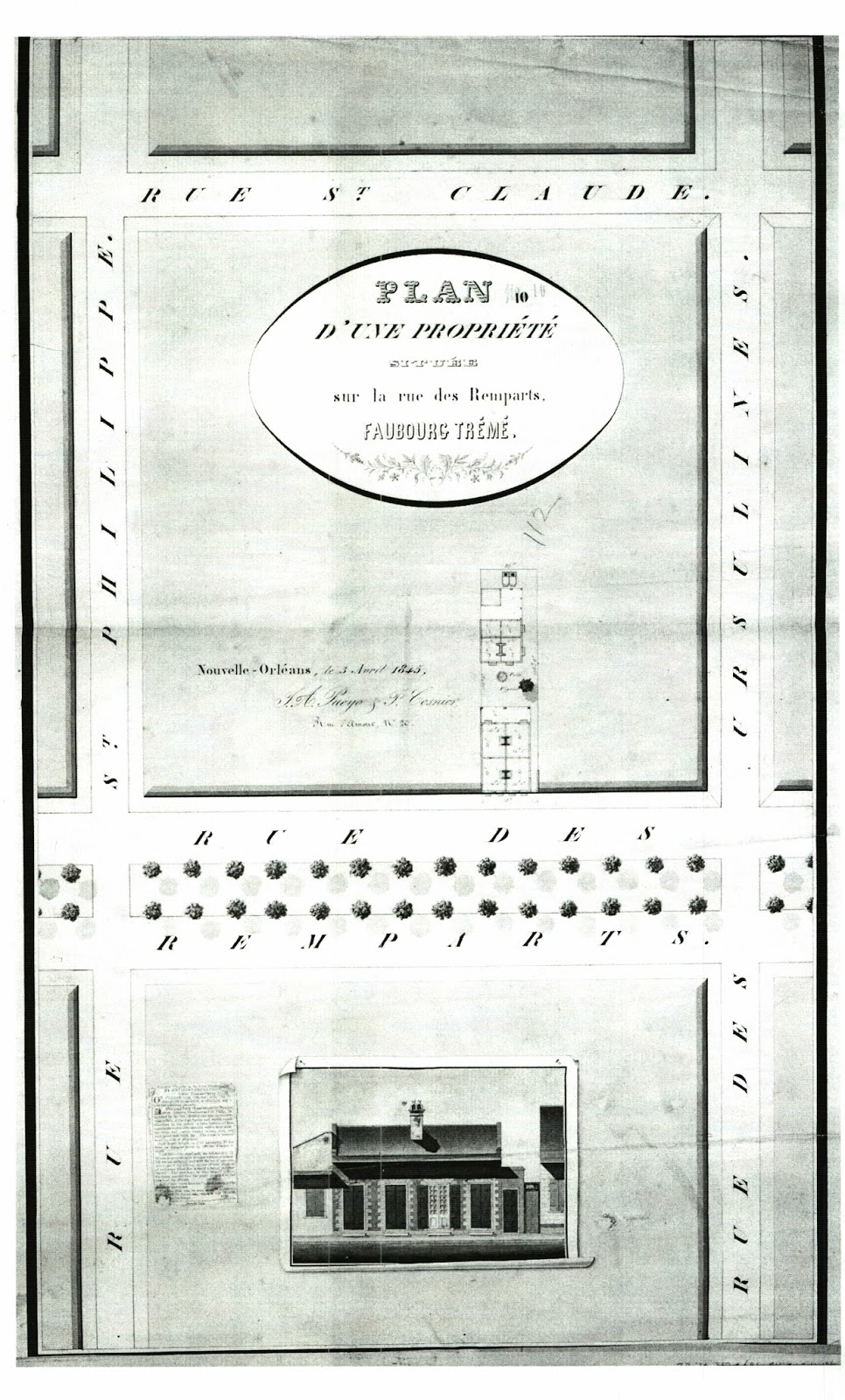
I finally have this last image which I love. I assume it is not the Lazzaretti-Bienvenu house, but I wanted to share the image. I bought it today at the Notarial Archives. These are the wonderful watercolors made as advertisements when the property was sold by the sheriff. I paid $1.00 for this black and white image, but one can buy a very large mounted color poster for $350 which is lovely.


One can see the facade of the house and the floor plan - which has a second building in the back, and perhaps an outhouse in the very back? This property was put up for sale in April 1845. I was trying to find it on Google maps, but I believe it is gone. How sad. This is what I found in the approximate location:

Tuesday, January 19, 2016

A Missing Link (The NOLA Olivers)

Thru DNA connections I have two people who do not necessarily know one another, but they have the same ancestor in their trees. I haven't been able to communicate in a meaningful way with either cousin about their trees, so I don't know how much information/people in the trees is first hand knowledge of people they actually know.

Ancestry indicates that they are both 4th - 6th cousins, which means at a minimum a 3rd great grandparent is our connection.

The surname I find in both, well, all three trees actually, because of mine, is Oliver. I have a second great grandmother named Oliver. I do know, though, that she came from Ireland in the mid-1800s. And that is about all I know. I know some of her descendants, of course. :)

I have another DNA connected person (different branch, but I know where she fits) who I know has put some wrong information in her tree. I have told her about the error, but she has not made the change. So, with that tidbit, I know to approach other people's public trees with caution.

I am trying to piece this man's life together and see if I can get further back. I have found his parents - lucky for me - but I still haven't jumped over the pond to Ireland.


And I can't get further back. Also, is his mother Ella or Ellen? A search in the Orleans Parish Marriage records comes up with nothing for a William and Ella/Ellen. (That doesn't mean anything, of course...) But I haven't been able to find anything about them. I suppose I might conclude that they - William and Ella - do not live in New Orleans. Why would I think they do? Perhaps Joseph Mack Oliver moved to New Orleans from elsewhere and then settled and married here. Maybe he is the first of my branch of Olivers to live in NOLA.

WAIT! As I write this I remember that one census indicated that Joseph Mack Oliver was born in Texas. If that were true - all other census indicate that he was born in Louisiana - then perhaps William and Ella/Ellen are in Texas and I am searching entirely in the wrong state. Though it does appear that William was a witness to the wedding, which would bring him back to NOLA. Though he might have traveled for the joyous occasion.

But, we also have an obituary which indicates that Joseph Mack Oliver had a sister and half brother... a sister he calls Lita and a half brother he calls Peter Tatum. We see Peter in some of the census documents living with Joseph or his children. I guess I need to get back to writing that life story and see what I can tease out.

And, am I jumping to conclusions on the name of the father? Maybe that is not shorthand for William. Maybe it is another name entirely.

I am getting discouraged enough to start entering all the Oliver marriages before a certain date in to Ancestry to see what pops up. Silly and a huge waste of time, isn't it? But that is what I am thinking. I should just finish writing the story of Joseph Mack Oliver and see what trails I determine and explore those.

Thursday, January 14, 2016

New Orleans Cousins

I have fallen in love with New Orleans. There is something about the city which hits me viscerally. I have no way to explain it. And it's not the Creole or Cajun food or the jazz music particularly... it's the architecture and feel of the city. Wait, I need to amend that, as I love the Zydeco music!) I don't know what it is really, but I am very happy in New Orleans, but not for the reasons others may love NOLA.

You may understand, then, how excited I was to find a DNA connection with people born in New Orleans. Now I have fantasies that my DNA aligns to the city like a compass to magnetic north! I have not yet been able to connect their trees to my tree, but they also have Irish heritage and they have the Oliver name in their tree, as do I, through my 2nd great grandmother. Though my second great grandmother and her husband settled in Troy, NY, not Louisiana. So, where is the split? Did one of her brothers go to NOLA while she headed to NY? Or was the immigrant further up the tree?

I have communicated (and soon to meet) a fellow genealogist who is related the the wife of the man I believe to be the patriarch of the branch I am researching - so the younger generations tie us together, but we are not biologically related. She has not researched the Oliver family in New Orleans, but perhaps she can point me to some of the resources not yet available on Ancestry.com which can help me climb the tree. My new friend has been researching for 20 years.

Thursday, July 16, 2015

Marge Luttrell Encaustic

I am sorry I didn't get to speak to the artist at the Central Pennsylvania Art Festival because Ms. Luttrell's works looked great. I noticed that she incorporated old photographs in her work. He art made me think of another artist from Tennessee, Beverly Hayden, who we met here.

I overheard Ms. Luttrell talking with another admirer about her process - encaustic - and the fact that she teaches the process - this August in Peter's Valley School of Crafts in New Jersey. I found this definition of encaustic at the Encaustic Art Institute.
Encaustic is a Greek word meaning “to heat or burn in” (enkaustikos). Heat is used throughout the process, from melting the beeswax and varnish to fusing the layers of wax. Encaustic consists of natural bees wax and dammar resin (crystallized tree sap). The medium can be used alone for its transparency or adhesive qualities or used pigmented. Pigments may be added to the medium, or purchased colored with traditional artist pigments. The medium is melted and applied with a brush or any tool the artist wishes to create from. Each layer is then reheated to fuse it to the previous layer.
Ms. Luttrell explains her process as such:
Featuring torn letters, maps, bits of script and old ephemera from bygones past, Margie Luttrell’s encaustic collages tease the viewer by awakening a desire for the rest of the story. Fascinated by language, symbols and the textures of all things aged, Luttrell builds levels of meaning and information into each piece.
The goal is to take images from one time period in order to construct another, then exploring how the mind jumps back and forth between the two and transcends interpretation.
Marge Luttrell hails from Tennessee by way of New Jersey. A collage artist for over forty years she discovered the inherent joys of wax painting (encaustic) seven years ago.
She is the recipient of a Fulbright, a National Endowment for the Arts Grant and A National Endowment for the Humanities Grant. Last year she lived and worked as an artist/teacher in Switzerland.

I took this image from her web site:


It turns out Ms. Luttrell was at Jazz Fest in NOLA this year with another artist we talked about earlier. I am sorry I didn't get the chance to see her work when I was there. Also, interestingly, she was in Turkey earlier this year as well, according to her promotional card.

Sunday, July 12, 2015

Recycled T-shirts, turned into skirts - Loveworn

I met BJ McHugh of Loveworn at the Central Pennsylvania Arts Festival over the July 10th weekend in State College, Pa. BJ hails from Cincinnati, Ohio, where she makes new pieces of clothing out of recycled t-shirts. She will even make you a custom piece out of your saved t-shirts - you know those t-shirts you never wear but don't want to toss because they meant something to you once upon a time. (A skirt or hoodie seems more practical to me than a quilt, which is another idea for old t-shirts; or a rag rug, but you would never see the t-shirts anymore in the rug... Just thinking out loud)

Looking at her web site it seems that she has many more styles than she brought to the Central Pennsylvania Arts Festival. Here are a few images I took from her web site:

Little Girl's skirt - had to be fun piecing this together


Woman's jacket - wouldn't this be great made from your old t-shirts?

Women's skirt with a cute pocket

I was disappointed that she only had a few in my size - maybe that says more about me than her inventory - but I bought a lovely black and grey short skirt with a draw-string waist.

I am disappointed that I didn't find a post on another woman I stumbled upon in New Orleans who makes wrap skirts from neckties. I bought one of her fun skirts, too. I will have to see what  have in my files and introduce you to her.

Searching the term recycle, though, I found another of my fiber artists - MsCrochetJig - who uses soda top tabs in her purses.


Sunday, May 10, 2015

Basin Seafood & Spirits - A Review

My husband and I just found ourselves here - no one having mentioned the restaurant to us. The restaurant seems to have a very unassuming presence on Magazine Street - almost to the point that it would be very easy to over look.
I am very glad we did not overlook it, because we were delighted enough to dine on Saturday night and return on Sunday for brunch. I thought the Octopus Ceviche - Orange and Lime Juice, Habanero, Avocado, Red Onions, Cilantro, Jicama Slaw - and Smoked Snapper Dip served with Crostinis - were fabulous. Well worth the trip. The next day I dined on the Fried Green Tomatoes Benedict. The brunch portion did seem small, but they made up for it with bottomless mimosas at something like $14. (But, I had things to do, so I had to limit myself on those!)

They describe themselves thusly:
The idea for Basin began several years ago when Chef and Owner of Baru, Edgar Caro, returned from a fishing trip with his friends. He caught a snapper and made it into a dockside ceviche. His friends said it was one of the best fish preparations they had ever tasted.
​
​Along with his friend Antonio Mata, they decided to open Basin, a seafood restaurant serving modernized, lighter versions of traditional Louisiana dishes. Basin sources the best possible ingredients from local sources, highlighting seasonal vegetables and Gulf fish in our daily specials.
​​​​​​​​​​​​​​​​​​​​​​
Basin offers sidewalk seating along the busiest sector of Magazine Street. We also have a lush courtyard for additional seating and a relaxing escape from the city.

Basin located at 3222 Magazine Street New Orleans, LA 70115 504.302.7391
And they are open Monday - Thursday 1130am to 10pm Friday - Saturday 1130am to 10pm Sunday 1130am to 9pm
HAPPY HOUR Weekdays 3pm to 7pm - One day I will have to go to a happy hour when they serve Local Craft Drafts $3, Happy Hour Food Items $4, House Wines by the glass $5 and Cocktail of the Day $5