Thursday, July 28, 2016

Brick Wall comes down - Anna Brechbill

I found the name of a second great grandmother of my husband's - Anna Brechbill. Unfortunately, no other little leaves are shaking at me, but a name! A family! And it is an unusual name! She shows up on the death certificates of three of her children.

I guess this will take a little more digging and not a passive receipt of information. Shoot. Eventually I need to get myself to Western Pennsylvania to do the original research.

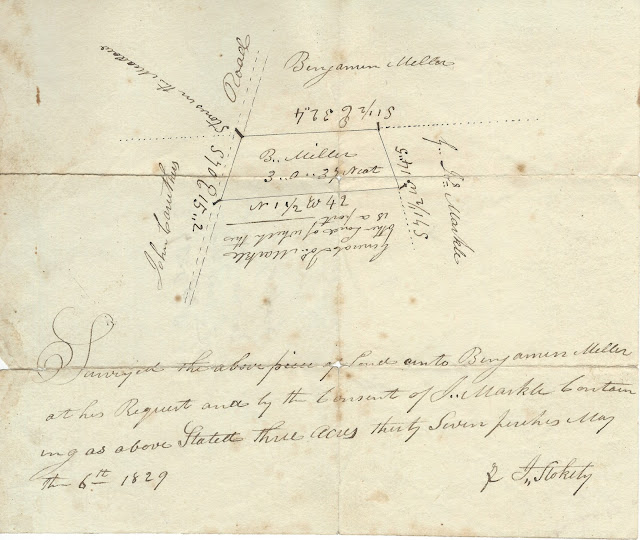
I did discover - or should I say rediscover - an 1829 survey among mu husband's papers. It has a name on it - Benjamin Miller - though I have not connected *that* name to the tree. John A. Miller, yes, so I am assuming Benjamin is a father or grandfather, but I don't yet know. I mean, why else would my husband have that survey if it weren't a family member. I have several deeds and sales receipts for land owned by the family over time.

The daughter of John A Miller, Lucy Miller, married Thomas Robertson and died young, before her father. I lucked out and found a Will for John A. Miller and he names his children and grandchildren, of which one is my husband's grandfather. Such good stuff!
Wednesday, July 27, 2016

The cost of losing sleep

We've talked and thought about this multiple times in this blog - here, here and here. Just more information that we need to take sleep seriously.

Sleep often takes a backseat to work or parenting, but new research suggests that sacrificing slumber for productivity is a bad trade-off. Surveys of 22,000 Americans show that people who slept five hours or less on an average weeknight were 28 percent more likely to have had a cold in the past month than those who averaged at least seven hours. Worse still, Reuters.com reports, the sleep-challenged subjects were 82 percent more likely to report battling the flu, pneumonia, or an ear infection. The study doesn’t prove that sleep loss increases susceptibility to infections, but researchers note that sleep deprivation does hinder infection-fighting white blood cells. Moreover, people who are chronically tired may also be less likely to exercise or follow a healthy diet. Says study author Aric Prather, “It is our hope that this work will help raise the profile of sleep as a critical health behavior.”

Taken from the April 29th edition of The Week Magazine.

Tuesday, July 26, 2016

The dinosaurs’ gradual decline

Uh-oh. And the uh-oh is for: 'in the fifth mass extinction.' I think we need to think about that more.... there have been five mass extinctions in the past *that we know about.* Why are we so arrogant to think we aren't going to fall to the same fate? I guess there are scientists out there who know this is a matter of when not if... but this is not a discussion at any gatherings I attend.

We talked about previous elimination of competition here, with the 'hobbits'. And we know we are doing a great job wiping out frogs and other amphibians... so, we are helping this demise along, thank you very much.


Paleontologists have long argued over exactly what annihilated the dinosaurs 66 million years ago, though most agree it was some immense catastrophe, most likely an asteroid smashing into Mexico’s Yucatán Peninsula, massive volcanic eruptions, or both. Recent research, however, puts a new twist in this prehistoric scenario, suggesting that dinosaurs were experiencing a slow decline long before cataclysmic events finished them off for good. When Nyasasaurus and the other early dinosaurs first appeared, more than 230 million years ago, they quickly evolved into new species, filling a wide range of ecological niches. But an analysis of three large dinosaur family trees reveals that most of these groups were dying off faster than new species could emerge to replace them. This decline began unfolding some 50 million years before dinosaurs were ultimately wiped out, in the fifth mass extinction that marked the end of the Cretaceous period, reports The Washington Post. With fewer species and less variation in habitats, paleontologists speculate, dinosaurs became more vulnerable to changes in their environment, making their demise inevitable. “While the asteroid impact is still the prime candidate for the dinosaurs’ final disappearance,” says study author Manabu Sakamoto of Britain’s University of Reading, “it is clear that they were already past their prime in an evolutionary sense.”

Article taken from the May 6th edition of The Week Magazine.

Monday, July 25, 2016

The genetics of virginity

Holy Shit. First off, a) why did scientists ask the question and then b) how did they go about determining the answer?

And second, they are only talking about women/girls with the remark about lower educational achievement, poorer physical and mental health... I mean, that doesn't affect the sperm donor, does it? Or is 'risk-taking' also associated with not taking very good care of oneself... kinda like a death wish, but making sure you have children before that reckless deathwish removes you from the gene pool?

The age at which people lose their virginity depends on a variety of factors, such as peer pressure, religion, parental guidance, culture, and, of course, opportunity. But new research suggests that to some extent, the timing of this rite of passage may also be influenced by genes. After studying the genomes of more than 380,000 people, British geneticists calculated that DNA differences could account for 25 percent of the variation in when their subjects had sex for the first time. Overall, they identified 38 sections of DNA involved in this milestone, including gene variants that affect behavior, personality, and the onset of puberty. Not surprisingly, perhaps, genes linked to risk-taking were associated with an early loss of virginity and producing a large number of children. Meanwhile, another gene, associated with irritability, was found in people who put off having sex, which in the grand scheme is not necessarily a bad thing. First sexual experiences and first childbirth at relatively early ages “have been associated with lower educational achievement, poorer physical health, poorer mental health,” researcher John Perry of Cambridge University tells Scientific American—“a complex web of negative stuff.”

Blurb taken from the May 6th edition of The Week Magazine.

Sunday, July 24, 2016

Arthur K. Drake

My wish came true! A family member - a niece - of Mr. Drake has found the WWI Ambulance Corps tree on Ancestry.com and contacted me. I hope she reads this blog as it pertains to Herb's letters home from France and Allentown, Pa, as I suggested, as she might enjoy it. I think she was hoping that I had more information... but what I did have is at least interesting, if she didn't already know about his capture and his involvement with the Ambulance Corps... Everything I had was attached to his entry in the tree, so perhaps she has what she needs/wants. I do hope she responds some more so we might learn about the type of man Arthur Drake was.

Saturday, July 23, 2016

Whole grains boost longevity

Photo and aricle taken from The Week Magazine - July 1, 2016 edition.

At least they are not advocating for white flour... and I suppose wild rice isn't mentioned because it is a seed, rather than a grain. I still find that I am happier without the grains in general... though I did just make some sourdough bread with kefir as the liquid and I ground my own wheat berries in my nutribullet. I also let the dough rise for over 24 hours. I am *hoping* the natural yeast and other microbes digested some of the grains so that it is easier for me to digest if I should indulge in a slice or two with grass fed butter.

Eating whole grains like oats, quinoa, and brown rice can help you live longer, new research suggests. A meta-analysis of 14 long-term studies involving nearly 800,000 men and women found the people who ate three or more servings of whole grains (48 grams) each day had a 20 percent lower risk of dying early than those who ate none, NBCNews .com reports. Having three servings of whole grains per day was also associated with a 25 percent lower risk of death from heart disease and a 14 percent lower risk of death from cancer than just one daily serving. “There are many biological pathways that would explain why whole grains are beneficial,” says study author Qi Sun of Harvard University’s School of Public Health. Unlike white or refined grains that have been milled and stripped of their nutrients, whole grains contain the entire grain kernel, which provides fiber, iron, and several B vitamins. Fiber improves cholesterol levels, helps insulin sensitivity, and promotes satiety—the feeling of being full after eating—which reduces the risk for obesity-related health issues and stroke.

Sunday, July 17, 2016

Transgender and Family Research

Photo taken from here.


Roughly 1.4 million adults who live in the United States are transgender, or about 0.6 percent of the population, according to a new report by UCLA's Williams Institute, the country's leading researcher on LGBT demographics. That's double the institute's previous population estimates, released in 2011.

In the context of my interest in family history and health:


  1. I wonder how one would research this in the future? I mean, how would you know when someone changed their gender based on legal documents? In the past, I am sure it was rather hush-hush. As I write this, I wonder what happens in India (the Hijra) and Albania (Balkan Sworn Virgins), for example, when there is a culture of people either being a third gender or the women who, for economic reasons for example, change genders, though not actually changing genders, just living culturally as the other gender. My mother-in-law was given a truly masculine name upon her birth and changed it legally to a cute woman's name either when she changed to her married name, or perhaps before. I should imagine her name will baffle any cousins doing the research in the future who do not know one of us to ask.
  2. Does American, with it's Standard American Diet, have proportionally more people who identify as transgender than we did throughout history? Is it our food? American air? Does the West have more than the East - or did Western culture make people hide it more than India, Pakistan, and Bangladesh did, obviously? What are the percentages in the rest of the world?
I don't mean to disrespect third gender or transgender people. People should live the way that does not contradict their soul. I just wonder if food choices and the chemicals and antibiotics Westerners (or maybe just North Americans, as Europeans do have more laws) put into the food, is changing the sex hormones in the human body so that babies are born with a gender that contradicts their soul.

Original blurb above taken from the July 15th edition of The Week Magazine.


Thursday, July 14, 2016

Exercise lowers cancer risk

Taken from the June 3rd edition of the Week Magazine.

Doesn't this seem obvious? Not the cancer connection specifically, but health in general. Who paid for this study and why? I read that esophageal cancer is associated with the elimination of the bacteria H. pylori... Back to eating those homemade fermented pickles... I don't think 7% will be enough to get people to get up off the couch.

Photo taken from here

If a healthy heart and trim waistline aren’t enough incentive, maybe a lower risk for cancer will inspire sedentary people to get moving. A new study from the National Cancer Institute shows that exercise may significantly lower the risk for 13 different forms of the disease, Time.com reports. Researchers analyzed 11 years of data on the health, diet, and activity of 1.4 million people and found that a higher level of physical exertion was associated with a 7 percent lower overall chance of developing cancer. Just a few hours of weekly exercise had a particular effect on esophageal cancer, lowering the risk for the disease by 42 percent. Working out also cut the risk for lung, kidney, stomach, and endometrial cancers by more than 20 percent and significantly reduced the likelihood that people would suffer from leukemia, colon cancer, or breast cancer. The more active people were, the more their risk dropped, notes study leader Steven Moore. “Cancer is a very feared disease,” he says. “But if people understand that physical activity can influence their risk for cancer, then that might provide yet one more motivating factor to become active.”

Wednesday, July 13, 2016

Olive Lee is accepted to college

We are talking going to college in 1922 for a woman. I am very happy about it. As we have already mentioned, Herb was the first to "attend" college in my family, at least the Kirkpatrick/Wright side. I assume the Lee side, too. But Olive graduated! I should imagine her parents were exceedingly proud. I am, 94 years later.


So, no long essays, I guess. What a difference a century makes for applying to college!

We see that Secretary Doris L. Crockett signed Olive's acceptance letter. It seems that Secretary Crockett became Dean Crockett and has an award named after her:
Crockett Medal Award

(Dean Doris L. Crockett award for distinguished service)
Criteria:
To be considered for the Crockett Medal Award, the highest award given by the Alumnae Association, candidates should meet the following qualifications:
Should have shown loyalty to and consistent interest in the College.
To have demonstrated outstanding achievement in a chosen career field or in significant community service.
Be recognized for having high level of integrity of character.

Tuesday, July 12, 2016

A Cellphone-Cancer Connection

I can't see how it is good for us. Of course most of us use headphones or are staring at the screen more than holding it to our heads as phones.


A new government study is reigniting the debate over whether cellphones can cause cancer. Researchers at the National Institutes of Health found that male rats exposed to cellphone radiation for nine hours a day were more likely to develop brain cancers known as gliomas, as well as tumors in the heart called schwannomas. The longer the rats were exposed, the higher their incidence of these rare tumors, NBCNews.com reports. Complete results from the $25 million study won’t be available until next year, but with more than 90 percent of American adults using mobile devices, the researchers decided their initial findings warranted an early release. “We felt it was important to get that word out,” says toxicologist John Bucher. “Overall, we feel that the tumors are likely to be related to the exposures.” The study, however, produced some conflicting results. Oddly, female rats showed no effects from the radiation, while male rats exposed to radiation actually lived longer than male rats not exposed. Critics argue that research involving rats may not apply to people—indeed, brain cancer rates in the U.S. have not increased since the 1990s, when cellphones first became widespread. But Bucher said 70 to 80 percent of experts who reviewed the study concluded cellphone radiation did raise the risk of cancer in the exposed rats.

Taken from The Week's June 17th edition.