Friday, August 12, 2016

Getting closer to answers (of as yet unasked questions)

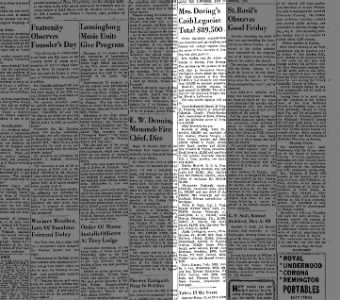
Another estate spoken of in the newspapers.... This time for Berdella Doring, the widow of Joseph C. Doring, a jeweler of Troy, NY.

I have several photographs and mentions of a Berdella in all my family stuff. I have photographs of the Lees in Mr. Doring's garden, for example. I wish I had them neatly labeled on my computer to share within this post. Not to mention to look at, just in case more clues can be had.

Take a look to this post which has a photograph of Berdella with Margaret and Olive. Herb mentions giving her one of his photographs here. And I suspect Berdella Ewig of York, PA is also in that photograph shown in the above post. I guess that is Berdella's daughter, Berdella.  What an unusual name. I guess now I can do some research on that family! I don't think I knew Berdella and Mr. Doring were together. Yay!

For a better look at the article, check here.


Mrs. Doring and Ada Sherman


Sisters Ada and Nellie Jane Kirkpatrick were kindly left a little something from Berdella Doring. How thoughtful of her. (I am currently wearing a beautiful, but worthless, topaz ring that was Nellie Jane's... I wonder if this was purchased at Mr. Doring's store. Seems likely, perhaps, if Oliver bought it for Nellie Jane.)


Wednesday, August 10, 2016

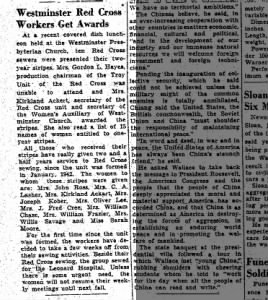
Nellie Jane and the Red Cross

Seems that Nellie Jane did her part to help the War effort. I wish I knew what it was that they were sewing. I wonder what she might have done to help during The World War, other than worry about Herb. (I hope I didn't transcribe some hint in Herb's letters but not remember it right now.)

The Red Cross and Nellie Jane

I wonder if Nellie Jane was a good sewer, or if, like me, no matter how hard she tried, her stitches (were necessary for the cause), but crooked and uneven. Was she ever found weeding a Victory Garden? Did she cultivate worms? Did she worry about germs? Would she think her grandchildren are spoiled and obnoxious? Or would she be fiercely proud of her grandson who accelerated his time in high school so that he might serve in the Navy? Was she thankful that he was still a little young to be in the throes of the fighting?

Monday, August 8, 2016

How elephants defy cancer

What about Asian elephants? How genetically similar are Asian and African elephants? If we share like 99% of our genetic code with mice, then they have to be very similar, don't they?

What does he mean that it's up to us because evolution had 55 million years to figure it out? Elephants got the gene, we didn't... maybe elephants are more important than we are... like Star Trek's whales.

Back to the discussion of evolution....

Photo and article taken from The Week Magazine - October 30, 2015
As the world’s largest land mammals, elephants should suffer one of the highest cancer rates—they simply have far more cells that could potentially mutate and become malignant. But new research reveals that elephants rarely get cancer—and the reason why may help in the search for human treatments, New Scientist reports. Only about 4.8 percent of elephants die from cancer, compared with up to 25 percent of humans. The key to the discrepancy, scientists say, is found in the genome of the African elephant. Elephants have 20 pairs of a gene called TP53, which produces a tumor-suppressing protein that prevents cells from dividing in an uncontrolled way. Humans, by contrast, have just one pair of this critical gene. Rather than repairing damage at a faster rate, elephants’ cells self-destruct to avoid passing along potentially harmful mutations. The researchers say their findings could lead to new developments in human cancer treatments. “Evolution has had 55 million years to figure out how to avoid cancer,” says the study’s leader, Joshua Schiffman. “Now I think it’s up to us to take a page out of nature’s playbook and learn how to take this information and apply it to those who need it most.”

Sunday, August 7, 2016

Wine may help control diabetes

Too bad I took so long to bring this little tidbit to my readers.... from the October 30, 2015 edition of The Week Magazine. I am sifting through the papers on my desk... Finally getting rid of some of the piles.

People with Type 2 (adult-onset) diabetes are often advised that a moderate amount of alcohol won’t exacerbate their condition, but a new study suggests indulging in a nightly glass of wine might actually help. Researchers instructed 224 adults with the disease to drink 5 ounces of mineral water, white wine, or red wine with dinner for two years, TechTimes.com reports. The participants, who were previously teetotalers, also followed a heart-healthy Mediterranean diet rich in plant-based foods, whole grains, nuts, and healthy fats. People with Type 2 diabetes are at greater risk for heart disease, but those who drank red wine increased their HDL, or “good,” cholesterol levels by about 10 percent and experienced fewer metabolic conditions, such as high blood pressure. Meanwhile, the red or white wine drinkers who were genetically identified as “slow alcohol metabolizers” saw improvements in their blood sugar control. Although red wine proved most effective against diabetes, the study’s senior author, professor Iris Shai, recommends that people “enjoy both wines in moderation, and as part of a healthy diet.”

Saturday, August 6, 2016

Furniture left to the Lees in Kate Clexton's Will

What hints can we take from this article? First off, weird that this is published in the Troy Record newspaper. I guess the value of estates is public information, but still... now we know that the Lees have some furniture that someone thought was significant enough (significant, but not necessarily valuable... admired?) to bequeath. I wish I knew what/which pieces they were, as then maybe I could ween some of "the Tyranny of the Heirloom" pieces I am now contemplating reupholstering! But, if they have lasted this long, I should save them - better than the crap made in China we buy nowadays, right?

We know this is Nellie Jane because her daughter is mentioned directly after her. Too bad I have not written anything about Margaret - though she is mentioned in Herb's letters.
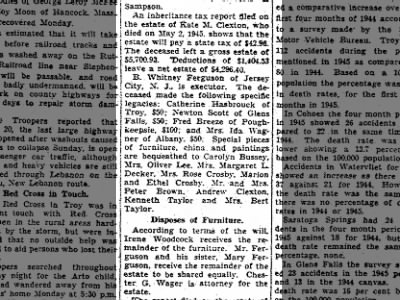
Who are these people and why are they leaving my family furniture?

But who is Kate M. Clexton? Merely a family friend? A neighbor? Could she have been a relative?

Doing a search on Ancestry.com she pops up in a tree created by Garth Burger, though I can't see anything. His information suggests she neither married nor had children. In 1865, at the same age as her cousin, 11, she was living with her aunt and uncle in Albany, NY. She was either born in Missouri or Indiana. By 1910 she is living alone - or at least as the head of household - and working in the Collar business. Of course this was a huge business in Troy and Olive worked for Cluett-Peabody her entire life. We find Kate again, as a collar worker and living as the head of household, in Troy in 1925.

In the 1940 census, she still lives as the head of household, though she no longer claims a profession. She does have a little more education than others on the same page - she claims 2 years of High School education.

So, was she gay? Was she fiercely independent or was she always sad she never had kids? Did she fight for women's suffrage as a young person? Was she so beautiful that she had so many suitors that she couldn't decide? Was she living in sin with the a man she met at work?

After contemplating my questions, I suspect she was a family friend. I can't find her in the Findagrave database, unfortunately. I just sent a message to Garth. Hopefully he will respond and have lots of information about his relative Kate Clexton.
Friday, August 5, 2016

Obesity hard to overcome

I seem to be finding tons of blog entries that I wrote, but never published.

We talked about diets tailored to individuals here. I wish people would get over the calories in and out idea and just 'Eat Food. Not too much. Mostly Plants' as wisely said by Michael Pollan. I think that nutritionist JJ Virgin has a great starting point with eliminating sugar, corn, peanuts, eggs, dairy, gluten, and soy for 21 days and seeing how you feel. You might surprise yourself. That is rather the base line theory of Mark Sisson's Primal, too, which has made some people very happy with the results. (Read the success stories on his Friday Mark's Daily Apple blog.)


On the popular reality TV series The Biggest Loser, obese people quickly shed 100 or more pounds through grueling workouts and drastic diets. New research reveals, however, that the show’s approach does not keep the pounds off long-term, because obese people’s bodies fight to regain the lost weight. A study involving 14 former contestants found that only one managed to stay slim after six years; the rest regained most or all of the lost weight. After conducting a series of tests, researchers from the National Institutes of Health found the contestants faced a losing battle because of a phenomenon called “metabolic adaptation,” Vox​.com reports. A person’s basal metabolic rate—the rate at which energy is used when the body is at rest—slows with weight loss or increased physical activity, as the body fights to maintain a stable weight. That problem was particularly acute for the show’s obese contestants, whose bodies burned 500 fewer calories a day than expected, making it nearly impossible for them to keep the weight off. The contestants also had low levels of leptin—a hormone that signals fullness after eating—so they were constantly hungry. “Clearly, The Biggest Loser dooms contestants to either a lifetime of superhuman weight-loss efforts, or weight regain,” says obesity specialist Yoni Freedhoff. He and other experts suggest that bariatric surgery or gradual weight loss are more likely to achieve long-lasting results.

The May 20th edition of the Week Magazine.

Thursday, August 4, 2016

Researching Oliver Lee in the Troy, NY Newspapers

Clearly being a letter carrier was a huge part of Oliver Lee's identity - in stark contrast with the Millenial archetype who lives for balance and recreation. Of the lucky times we find Oliver in newspapers, they are all about his profession. A couple articles have his image, which is always a tremendous find.

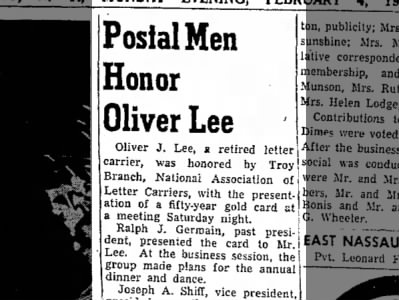
I have the fifty-year gold card mentioned in this article. Can I express in no uncertain terms how grateful I am for my great aunts that they saved these things? The card is about the size of a modern day business card. It is not made of gold... gold tone, shall we say?

I need to learn what is available at the National Archives for information on postal carriers. Someday maybe I will follow that lead...

Too bad there is no more information about Oliver in this article... now we move on to planning the dinner dance. I wonder if his daughters were in attendance along with wife Nellie Jane? Did he invite his sons to come? I believe he was living in Yonkers with his daughter Olive when this celebration took place. How dressed up did he get? Did the family agonize over what they would wear? Was this a big deal because they were humble people? Did he buy his wife a corsage so she would look pretty and feel special as he got his recognition? Did he have trouble walking? Was he called to a stage or merely to stand at his place? Did he end up drunk at the end of the meal? (Man, I am cruel, aren't I? But I am just imagining the possibilities.)

Postal Men Honor Oliver Lee
Add caption
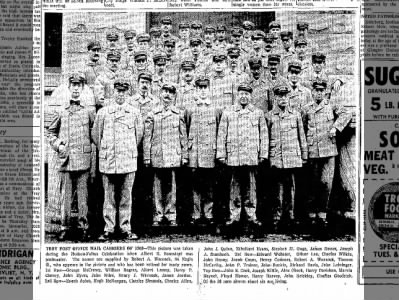
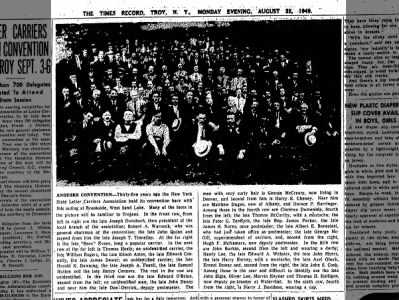
This next photograph appeared in the paper 6 years after Oliver's death. I guess it was in the paper because it was 50 years after the photograph was taken. I wish I knew how to highlight Oliver in the photographs for you, my readers.

Who submitted this photograph to the newspaper? Is there a letter carrier archive in Troy? Is there one proud letter carrier who has saved all this stuff? Man, I really need to spend more time on this.

Oliver Lee as a postal carrier in 1900

And there is absolutely no way to see him in this group, but he is called out by name, so someone liked him enough to do so.

Oliver Lee was clearly active and proud of his profession

Wednesday, August 3, 2016

Why bacteria are becoming drug-resistant

And here we go again... in the news, again. We are destined to kill ourselves with the superbugs.


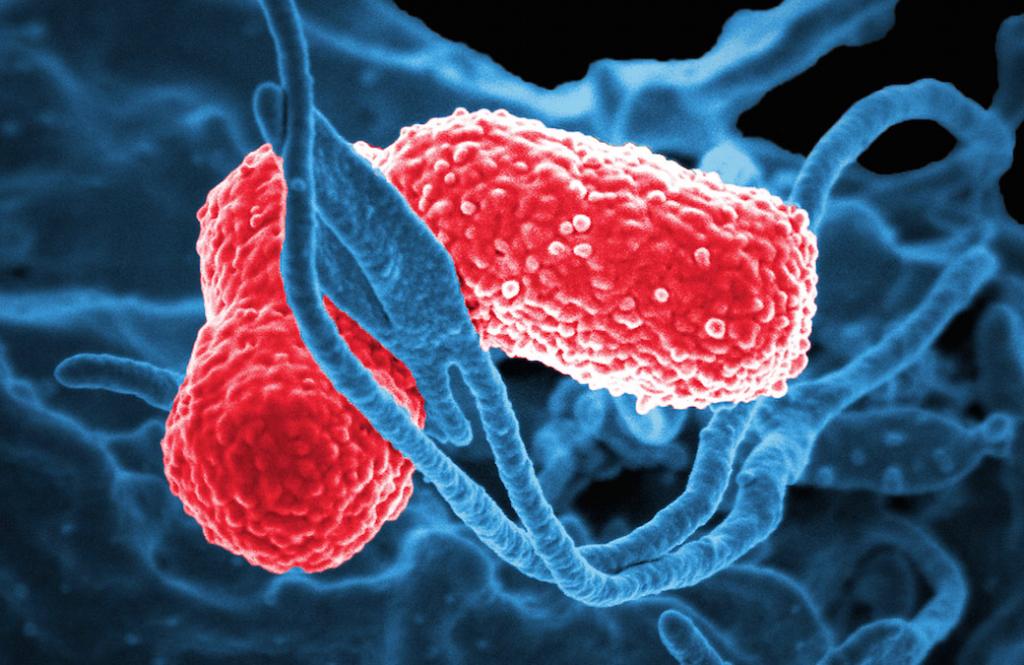
Drug-resistant Klebsiella pneumoniae bacteria
People suffering from bronchitis, flu, and other ailments often leave their doctor’s office with a prescription for ­antibiotics—even though in many cases it will do nothing to help them. Nearly one-third of the antibiotics taken in this country are unnecessary, says the U.S. Centers for Disease Control and Prevention (CDC), despite decades of warnings that overprescribing is helping fuel the alarming surge in drug-resistant superbugs. All told, the study found, some 47 million unwarranted antibiotic prescriptions are being written out each year. Many of them are for viral illnesses the drugs can’t treat, such as colds and sore throats, or for sinus infections, typically caused by fungi that aren’t affected by antibiotics. The researchers say it’s likely they’ve even underestimated the problem, because they didn’t consider antibiotics doled out over the phone and in urgent-care centers, or cases in which doctors prescribed the wrong antibiotic to treat a genuine bacterial infection. The danger of overprescribing is that once bacteria are exposed to an antibiotic, they start learning how to outsmart it, rendering that drug less effective or even useless. More than 2 million people a year are infected by drug-resistant germs, and some 23,000 die of their infections. If inappropriate antibiotic use continues, CDC Director Tom Frieden tells NBCNews.com, “we’ll lose the most powerful tool we have to fight life-threatening infections.”
THE WEEK
May 20, 2016

Monday, August 1, 2016

The new war on cancer


Amazing to think that this could cure cancer. Both Herbert (see his story beginning here) and his son, my dad, died of lung cancer; and lung seems to be one of the cancers this might cure. This treatment is pretty astonishing, really.

With all my discussion about evolving critters, here is one which we acknowledges changes quickly to outwit all our attempts to eliminate it.

Forty-five years after Richard Nixon declared “war” on the disease, cancer remains the No. 2 killer in the U.S., after heart disease. This year alone, an estimated 600,000 Americans will die of cancer. Attempts to find a “magic pill”—a global cancer treatment for hundreds of types of cancer—have failed. But more sophisticated forms of treatment targeted to specific kinds of cancer cells have resulted in much better survival rates for some common cancers, including breast, prostate, and colon cancer and some forms of leukemia. And recently, researchers have had very encouraging results with a new approach called immunotherapy. Some patients in advanced stages of the disease, who previously would have been deemed terminal, have undergone rapid and complete recoveries. Hoping to build on that progress, President Obama in January announced a $1 billion “moonshot” to cure cancer, putting Vice President Joe Biden—whose son Beau died of brain cancer last year—in charge of “mission control.” Biden believes a major breakthrough is possible. “We’re not looking at incremental change,” the vice president said. “What we’re trying to do is end up with a quantum leap on the path to a cure.”

How does immunotherapy work?
Unlike traditional cancer treatment methods that attack the cancer itself—surgery, chemotherapy, and radiation—immunotherapy works by encouraging the patient’s own immune system to fight the disease. The immune system often fails to mount a successful attack on cancer because tumors that develop from the body’s own healthy cells aren’t recognized as invaders. Some tumors even have ways of tricking the immune system into ignoring them. One type of immunotherapy transfers genetically engineered killer T cells back into a patient’s body; these superaggressive antibodies target and destroy the tumor. In another type, drugs known as checkpoint inhibitors block the cancer cells from turning off the usual T-cell defenses, enabling the body to fight the disease. “Patients respond to these drugs because their immune system is ready to go, but the tumor is protecting itself,” said Dr. Antoni Ribas, professor of medicine at University of California, Los Angeles. “For these patients, we just need to unleash the immune system.”

What success has it had?
In one trial, 93 percent of patients suffering from certain types of B-cell leukemias and lymphomas saw their cancer disappear. California businessman Johnny Crowell took part in another immunotherapy trial of just 10 patients after developing a rare Merkel cell cancer. Doctors had already told him that the cancer “would end up in my lungs, brain, back,” Crowell told The Atlantic. He was given two years to live. After Crowell took G100, a drug that increases the body’s immune response, doctors found no signs of cancer in any of the tissue they extracted from his body.

Are there any downsides?
Plenty, unfortunately. Immunotherapy drugs can cost up to $150,000 per year, and most people can get access to them only if they’re accepted into very small clinical trials. Moreover, it’s not clear whether immunotherapy will work with all cancers. The treatment seems to work best against cancer cells with high levels of genetic mutation, making the tumors more easily identifiable—as in lung cancer, where carcinogens in tobacco smoke trigger mutations. In diseases with fewer mutations, such as pancreatic cancer, immunotherapy seems to be far less effective. Since Nixon launched his campaign to cure cancer back in the 1970s, researchers have repeatedly run into the same obstacle: Cancer is really not one disease, but at least 300, involving different types of cells with abnormal genetic machinery that makes them grow out of control. “This is the emperor of all maladies,” says Professor Charles Swanton, from University College London’s Cancer Institute. “We’re dealing with an entity that’s constantly evolving, constantly adapting, and constantly changing its genome.”

What about other treatments?
Another promising new frontier is genetic analysis, which splits each type of cancer into dozens of subtypes, so that specific chemotherapy drugs can be tailored to each cancer. Experts also now hope they can use the breakthrough gene-editing technique called CRISPR to correct mutations in cancer cells, or perhaps “edit” out mutation-prone genes that people inherit.

Will the ‘moonshot’ really help?
Biden’s task as mission commander is to marshal all of these varied efforts into one coordinated response—bringing together researchers, philanthropists, Big Pharma, and insurers. Biden’s biggest challenge is to try to tackle what he calls the cancer politics: the infighting and jealousy that occur between cancer researchers, who often refuse to share their data with one another. The federal effort will also fund research into how different immunotherapy treatments work in combination with one another, as well as efforts to improve prevention and early detection. Just don’t expect a single, magical breakthrough. “The war on cancer will not be won in one dramatic battle,” says MIT cancer researcher Robert Weinberg. “It will be a series of skirmishes.”

Jimmy Carter’s miraculous recovery
In August 2015, former President Jimmy Carter announced he had been diagnosed with advanced melanoma, a type of skin cancer that had spread to his liver and brain. “I’m perfectly at ease with whatever comes,” said Carter, then 90. Four months later, Carter announced he was cancer-free. Along with radiation, Carter had been put on pembrolizumab (brand name Keytruda), a checkpoint inhibitor that stops cancer cells from blocking the immune system’s response. Soon after, Carter’s scans showed no evidence of the original cancer lesions on his brain, or any new lesions. Given that cancer can often reappear years down the line, oncologists prefer to talk in terms of “years of remission” rather than “cure”—but like Carter, some cancer patients on Keytruda have seen their disease disappear completely. Not surprisingly, says melanoma specialist Dr. Patrick Ott, Carter’s miraculous recovery has prompted patients across the country to demand, “I want what Jimmy Carter had.” Doctors caution that in clinical trials, Keytruda shrank the tumors in only 24 percent of patients, and that it only works on certain types of cancer.
THE WEEK
May 20, 2016

Friday, July 29, 2016

New species in the Himalayas


Ok, when it said 'new species' I thought of new species... like evolution... but a *new species* to Western Scientists. I keep thinking back on to the fact that animals are evolving every day, so a new species might just be an adaptation of an existing species which then died out because what was being 'selected' for took hold. You know, the whole theory of evolution... Does that make sense?

And, ahhhh, 4 days out of water? Ahhh, aren't these the invasive fish in some of the American waters?


A bright blue dwarf snakehead fish that can wriggle around on land for up to four days at a time and a snub-nosed monkey that sneezes when it rains: Those are just two of 211 new species found over the past five years in the Eastern Himalayas, the World Wildlife Federation reports. The region, which spans central Nepal, Myanmar, and Bhutan, as well as northeastern India and southern Tibet, has seen the discovery of 26 fish, 133 plants, 39 invertebrates, 10 amphibians, one reptile, a bird, and a mammal. The question is, How long will they survive? Researchers say many of these newly found species are under mortal threat—climate change, deforestation, poaching, and pollution have left only 25 percent of the Eastern Himalayas’ original habitats intact. “These discoveries show that there is still a huge amount to learn about the species that share our world,” the WWF-UK’s chief adviser of species, Heather Sohl, tells The Guardian (U.K.). “It is a stark reminder that if we don’t act now to protect these fragile ecosystems, untold natural riches could be lost forever.”

Taken from the October 30, 2015 edition of The Week Magazine.